Fire & police unions, diverse faith groups, legal scholars rally behind City of Quincy at Massachusetts high court Powerful coalition defends city’s right to honor first responders with statues of Florian and Michael
Media Contact
Ryan Colby 202-349-7219 [email protected]
Additional Information
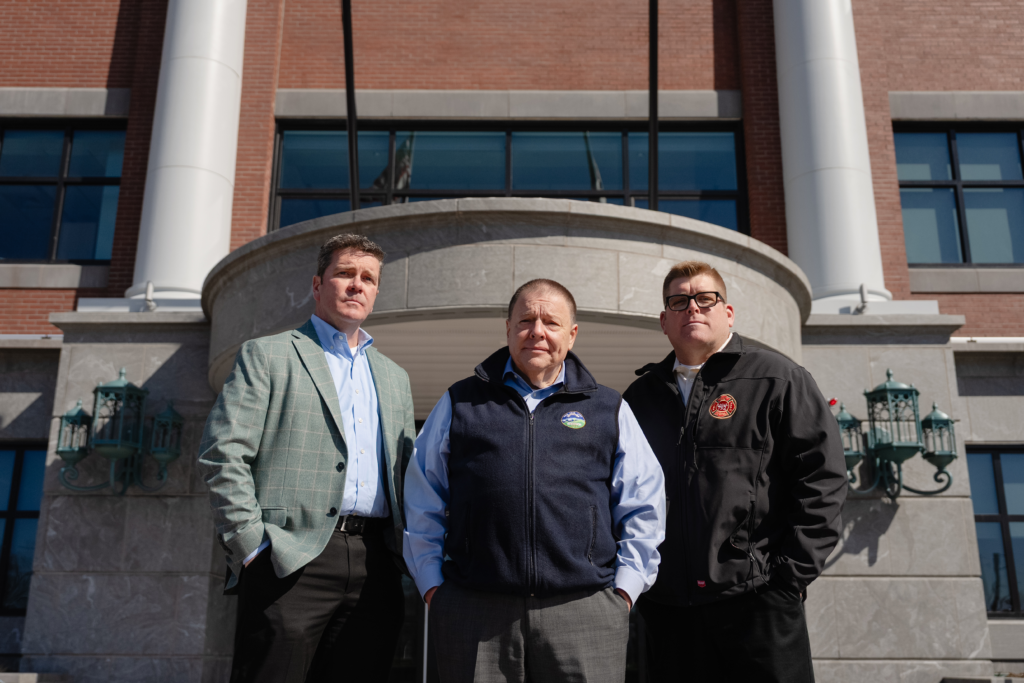
WASHINGTON – A powerful coalition of 18 organizations and scholars—including the nation’s largest firefighter and police unions, diverse faith groups, and prominent constitutional scholars—filed 12 friend-of-the-court briefs asking Massachusetts’ highest court to protect the City of Quincy’s freedom to honor its firefighters and police officers with Italian-made statues of Florian and Michael the Archangel.
In Fitzmaurice v. City of Quincy, the ACLU sued to stop the city from installing the statues on its new public safety headquarters, claiming that because the figures have religious significance to some, they could not be used to honor first responders. Last fall, a lower court judge blocked the installation of the statues, which are now sitting in storage.
Worldwide, first responders view Florian, an early Roman firefighter, and Michael the Archangel, long associated with being a protector against evil, as inspiring symbols of their professions. Fire departments often adopt the Florian cross, while police frequently identify with Michael in their mission to safeguard communities. To celebrate this proud tradition and pay tribute to the city’s public servants, Quincy commissioned statues of Florian and Michael from the same artist who created the city’s John Adams and John Hancock statues. Becket and Quincy’s city solicitor are fighting back against the ACLU’s lawsuit so Quincy won’t have to hide these civic symbols simply because some view them as religious.
Highlights from the filings include:
- The International Association of Fire Fighters and its Massachusetts affiliate explained the significance of Florian to firefighters from “vastly different walks of life, across thousands of milesand hundreds of years.”
- The National Association of Police Organizations noted that Michael is “the archetype of core law enforcement virtues: justice, courage, leadership, and defense of the innocent.”
- The National Fraternal Order of Police and its Massachusetts affiliate warned that the ACLU’s test would require the erasure of symbolism not just from police and firefighters, but from numerous other first responders of many faiths and none who rely for inspiration on symbols with religious origins.
- Quincy’s firefighters union and its two police unions reiterated that Quincy’s own first responders support the statues as symbolic of the virtues they hope to embody as they engage in their life-saving work.
- Michael McConnell—a renowned scholar of church-state law—and John Witte, Jr.—the author of the leading scholarship on the relevant provision of the Massachusetts Declaration of Rights—argued that Quincy’s statues are fully consistent with the Massachusetts Constitution, which does not require the erasure of all religious expression from public spaces.
- The Knights of Columbus highlighted the longstanding acknowledgment of religion both on the federal level and across the Commonwealth of Massachusetts, including through myriad examples of public art.
- The Islam and Religious Freedom Action Team and the Jewish Coalition for Religious Liberty highlighted how the harms of the ACLU’s attempt to purge religion from the public square would fall most heavily on minority faiths whose symbols are less familiar.
- The Synod of Bishops of the Russian Orthodox Church Outside of Russia described the importance of Florian and Michael across a host of faith traditions, including various traditions of Christianity, Judaism, Islam, and Santeria.
- The American Legion warned the court that adopting the ACLU’s test would place Massachusetts on a collision course with the First Amendment, which prohibits hostility toward religion.
- Protect the First Foundation reminded the court that the Lemon test—abandoned by the U.S. Supreme Court but advocated for by the ACLU—was rejected precisely because of its unworkability, chaotic results, and easy manipulation.
- The Massachusetts Family Institute urged the court to follow the original meaning of the Massachusetts Constitution, explaining that the challenge to the statues lacks any basis in history.
- The Pioneer New England Legal Foundation emphasized the unworkability of the test offered by the ACLU, which relies on “subjective judicial assessments.”
Statements for media use:
“We’re proud to stand with Quincy in this fight,” said Tom Bowes, president of Quincy’s Firefighters Local 792. “Firefighters have honored Florian for generations because he embodies the values at the heart of our work: courage, sacrifice, and service. The statues honor this tradition.”
“By picking this fight, the ACLU has pitted itself against the very heroes who keep our communities safe,” said Joseph Davis, senior counsel at Becket and an attorney for the City of Quincy. “This broad coalition of firefighters and police—along with diverse faith communities, public policy experts, and legal scholars—proves just how out of touch the ACLU has become. We’re hopeful the court will see through this attack and side with Quincy.”
Oral argument at the Massachusetts Supreme Judicial Court is scheduled for May 6, 2026.
For more information or to arrange an interview with a Becket attorney, contact Ryan Colby at [email protected] or 202-349-7219.