Indiana Civil Liberties Union v. Braun
Case Snapshot
A Ten Commandments monument stood on the Indiana Statehouse lawn for more than three decades—until 1991, when a vandal toppled and destroyed it. In 2000, Indiana sought to replace the monument with one featuring the Ten Commandments, the Bill of Rights, the Preamble to the 1851 Indiana Constitution, and a commemoration of the donor. But the vandal and the ACLU sued to stop the installation, and a lower court blocked it under a legal test that the Supreme Court has since abandoned. Now Indiana is fighting to bring the monument back to the statehouse.
Status
Indiana is asking a federal court to lift the order blocking the monument. In August 2026, Becket joined the case as co-counsel alongside the office of Indiana Attorney General Todd Rokita, represented by Solicitor General James Barta, to represent Governor Braun.
Share this Case
Case Summary
A statehouse tradition toppled
In 1958, Indiana placed a seven-foot-tall Ten Commandments monument on the statehouse lawn. Donated by the Fraternal Order of Eagles, it stood alongside other monuments and markers for 33 years. But in 1991, a vandal toppled and destroyed the monument, and was later convicted of criminal mischief. Indiana officials promised to replace what he had torn down.
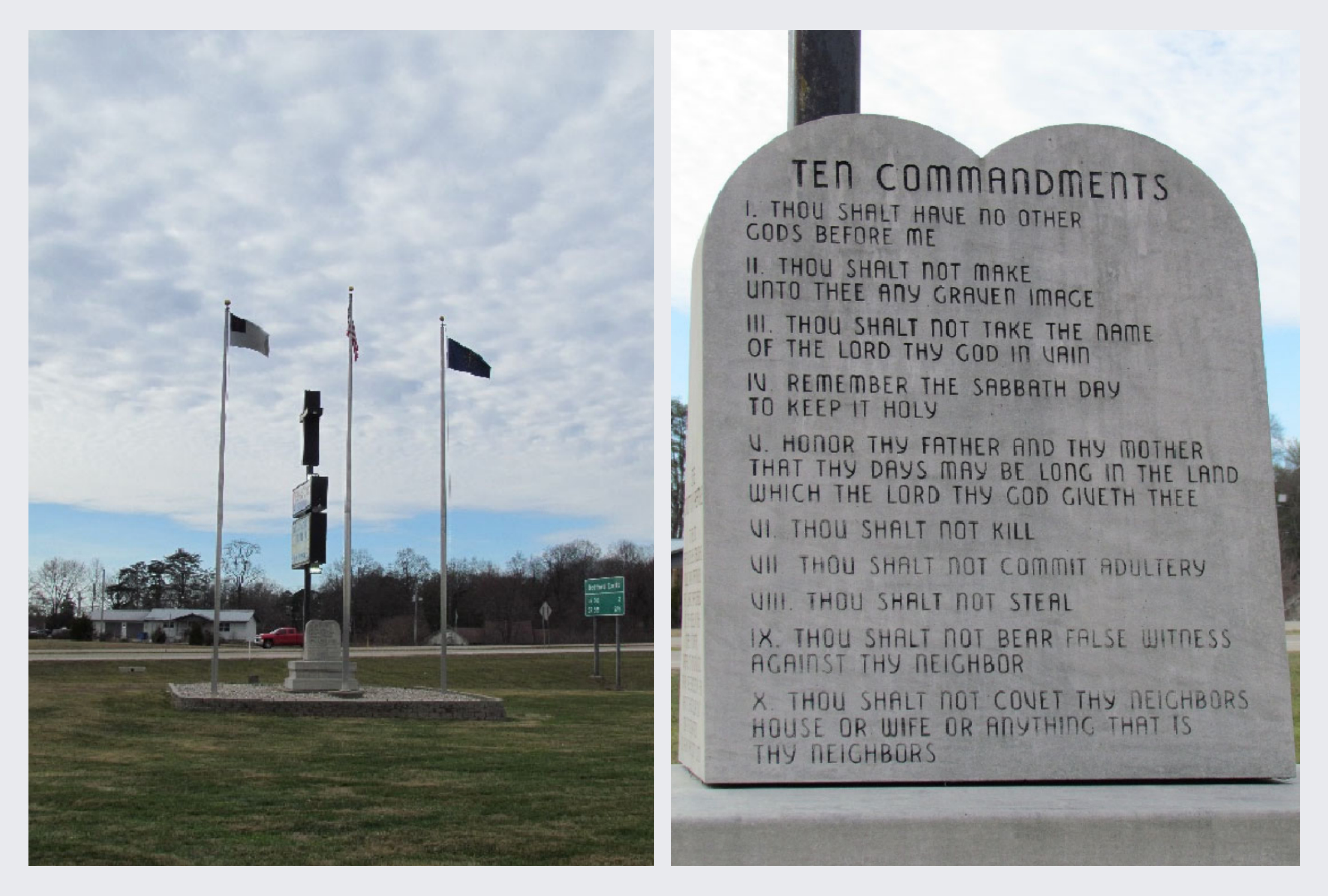
The Indiana Limestone Institute designed a new four-sided monument as a gift to the state. One side bears the Ten Commandments, another the Bill of Rights, and the remaining sides feature the Preamble to Indiana’s 1851 Constitution and a dedication acknowledging the donation by the limestone industry.
The ACLU tries to block monument’s return
In 2000, the ACLU and several others—including the vandal—sued to stop Indiana from installing the replacement at the statehouse. A federal district court blocked the monument under the Supreme Court’s Lemon test, a wrongheaded legal standard that encouraged courts to find violations of the Establishment Clause whenever government actions appeared to “endorse” religion. The Supreme Court declined to hear Indiana’s appeal in 2002. As a result, the replacement never reached the statehouse lawn and has instead spent more than two decades outside a church in Bedford, Indiana.
In the years since, the Supreme Court has rejected the legal reasoning behind Lemon and reaffirmed the place of religious symbols in American public life. In Van Orden v. Perry, the Court upheld a Ten Commandments monument at the Texas State Capitol against an Establishment Clause challenge, emphasizing the monument’s historical setting and context. Then, in Kennedy v. Bremerton School District, the Court formally abandoned the Lemon test and ruled that Establishment Clause cases should instead be judged by reference to history and tradition.
Becket helps the Hoosier State right an old wrong
In December 2025, Indiana Attorney General Todd Rokita asked the federal court to lift the order that has kept the replacement from the statehouse lawn, which rests on the now-defunct Lemon test. Indiana argues that the order cannot stand under current Supreme Court precedent, which interprets Establishment Clause claims in light of our nation’s history and traditions. The state’s decades-long history of displaying the Ten Commandments at the statehouse lawn bolsters its argument that restoring the monument is consistent with that standard.
The ACLU is still fighting to keep the monument off the lawn. Becket joined Indiana’s legal team in August 2026, arguing that the Constitution does not require the state to erase its history simply because that history includes religion.
Importance to Religious Liberty:
- Public square: Religion is a natural part of human culture and should not be scrubbed from the public square.