2025 Index Findings
Download the Summary One-Pager
Executive Summary
The seventh edition of the Religious Freedom Index marks another milestone, with the Index overall reaching its highest cumulative score yet (71). It also shows rising scores in several dimensions, most notably Religious Sharing, which measures Americans’ acceptance of the right to express faith beliefs and preach religious doctrines to others.
The Index is designed to give a holistic view of American attitudes toward religious freedom by surveying a nationally representative sample of approximately 1,000 American adults each year. The survey consists of 21 annual questions that cover a broad range of topics, from the rights of religious people to practice their respective faiths to the role of government in protecting religious beliefs. The responses to these questions are broken down into six dimensions: 1) Religious Pluralism, 2) Religion and Policy, 3) Religious Sharing, 4) Religion in Society, 5) Church and State, and 6) Religion in Action. The composite Index score is calculated by taking the average of these six dimensions, with a score of 0 representing complete opposition and a score of 100 representing complete support.
The Index also asks a number of questions every year that evaluate attitudes toward timely matters of national interest. This edition measured the attitudes of Americans toward several recent Supreme Court decisions, toward parental rights and school choice, and toward the role of religion in society. We also captured interesting data around which news sources Americans trust when it comes to reporting on religious liberty.
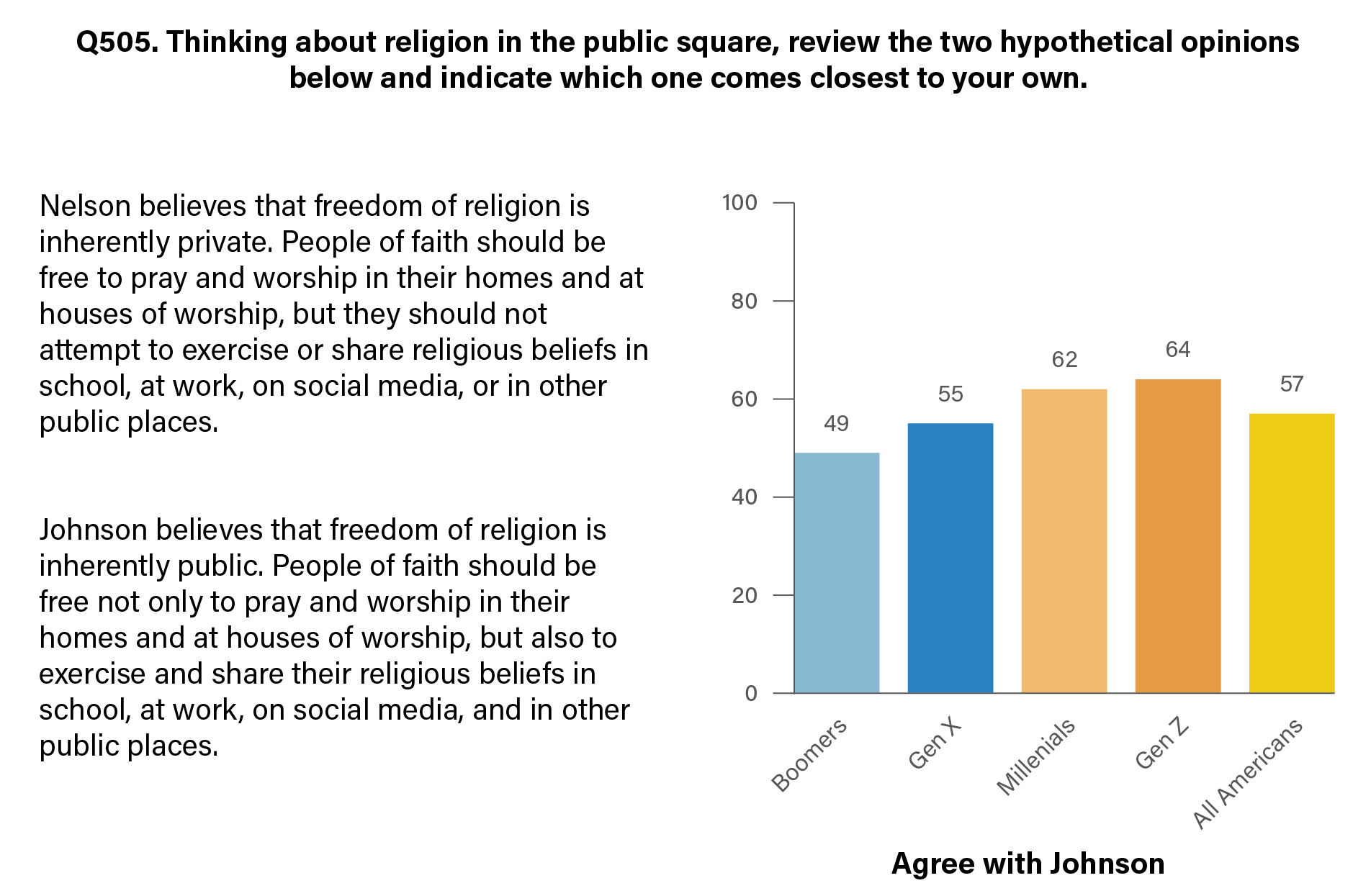
Faith in the public square is on the rise: This year saw a heartening jump in support for Religious Sharing, our Index dimension that measures support for the right to preach and share one’s faith in public. More Americans also say that freedom of religion is inherently public, jumping from a 52% agreement in 2020 to a stronger 57% agreement in this year’s Index. (See Religion in Society Dimension for details.)
The Church and State dimension also saw growth, with growing support for the ability of religious charities to receive public funds on the same terms as secular charities. Support is up slightly from last year and 10 points since 2019. A slight majority of Americans – 54% – now support displays of religious symbols in public displays.
These results and others show that Americans are moving away from a timid, behind closed-doors view of religious freedom and toward a conception that empowers individuals to pursue happiness according to their faith, at home, at church, at school and in the public square.
Religious freedom unifies Americans: Although Americans are divided on the question of trust in institutions, this year’s Index findings show that they rally together in support of religious freedom, and especially in defense of religious individuals against the state. Stand-out findings include:
- A plurality of Americans (47%) support the right of a Christian counselor to provide talk therapy to minors in an effort to help them become comfortable with their biological sex (compared to 26% who would support a state law prohibiting that therapy).
- Similarly, most Americans (58%) support the right of a Christian baker and cake artist to decline to design cakes that conflict with her sincere religious views.
- Nearly two-thirds (65%) of Americans agree with a recent Supreme Court ruling protecting the right of a Catholic nonprofit not to face discrimination by the government of Wisconsin because of its own refusal to discriminate on the basis of religion.
Far from being a source of division, religious liberty has the potential to unify the American people around one of our oldest and most ennobling guiding principles.
Americans support religious parents’ right to faithfully educate their children: In past editions of the Index, we’ve found that Americans strongly support the right of parents to opt their children out of content that they think is morally inappropriate. This year, we found that support for parental opt-outs rose again, from 69% last year to 73%.
In addition, several new questions were posed that probed Americans’ support for public money following students to the schools of their family’s choice. Three-quarters of Americans support the ability of parents to use school choice options (including tax credits and vouchers) to send their children to the school that best meets their needs – even if that school is a religious school.
We also found that Americans overwhelmingly (62%) support the Supreme Court’s recent landmark religious liberty case Mahmoud v. Taylor, finding that a public school violated the rights of parents by refusing to permit religious opt-outs from public school curriculum with LGBT+ themes for elementary schoolchildren. Taken together, these findings indicate that Americans are moving away from a one-size-fits-all conception of schooling and toward empowering parents to make the best decisions for their children.
2025 Index Results
The Index dimensions and scaled scores are as follows:
Religious Pluralism: 86 How do respondents view the basic rights to hold beliefs about God, adhere to a religion, and live out the basic tenets of that religion in their daily life, especially when those beliefs and practices may be outside the mainstream? The Index dimensions and scaled scores are as follows:
Religion in Society: 65 How does religion contribute to a healthy society, and how do people feel about the efforts of religion to make contributions within society?
Religion and Policy: 69 What is the proper place for religion when it intersects with law and policy?
Church and State: 60 What are the boundaries of interactions between government and religion?
Religion Sharing: 75 When someone follows a religion, to what extent should they be free to share their religion and beliefs with others?
Religion in Action: 69 How free are individuals to practice their beliefs beyond the walls of their homes or places of worship?
For the third year in a row, the Index has seen improvement, marking an all-time high score of 71. Likewise, three of its six dimensions have all-time high scores as well: Religious Sharing (75), Religion and Policy (69), and Church and State (60). A fourth dimension, Religious Pluralism, has held last year’s all-time high score of 86. Two dimensions, Religion in Action and Religion in Society, have dropped slightly from the all-time high scores they recorded last year, to 69 and 65 respectively.
As in prior years, the youngest generation – Gen Z – was at the forefront in several areas. They scored highest on Religious Sharing, helping push it to its new high score, and on Religion in Action. However, this year saw a sharp decline in their optimism – only 13% say that religion and people of faith are “definitely” part of the solution. This pessimism is part of why the score for the Religion and Society dimension dropped from 67 last year to 65 this year. This year’s Index also finds, particularly on some topics, a widening split among Gen Z respondents based on gender.
The opportunity to ask about a number of recent court cases concerning religious liberty – including several important Supreme Court decisions – gives this year’s Index a unique flavor. We found that Americans favor the recent Supreme Court rulings that solidify religious freedom and tend to side with the faithful and support their rights to live out their faith. Some of this may be due to Americans’ anti-institutional streak. Americans tend to stick up for “the little guy” and the religious plaintiffs in these cases – parents, cake designers, charities – are seeking a quintessentially American thing: the right to live out their faith without being second-guessed by overbearing government authorities.
The growth in half of the 2025 Index’s dimensions and sustainment of Religious Pluralism’s all-time high score from 2024’s Index is good news for American religious liberty. Even the dimensions that measured a decrease were still much higher than their all-time lows. Religion in Action, dropping 1 point from last year’s high score of 70, is still 4 points higher than its all-time low in 2020, and higher than its score of 68 in 2023 and 2022. And for Religion in Society, its score of 65 is 3 points higher than its all-time low of 62 in 2022 and 2020. Dimensions that showed improvement this year fared as well or better, with Religion and Policy and Church and State being 4 points higher than their low points, and Religious Sharing 6 points higher. Religious Pluralism, despite showing no movement in either direction this year, remains a staggering 9 points above its low point of 77 in 2020. Taken together, this adds up to a strong support for religious freedom and a shared understanding of the importance of America’s history of religious tolerance.
2025 Dimension Analysis
Religious Pluralism
The Religious Pluralism dimension asks respondents about how different belief systems and practices can simultaneously exist in society. They address the freedom to choose to follow a religion, or no religion at all, and what it means to live out that choice in daily life.
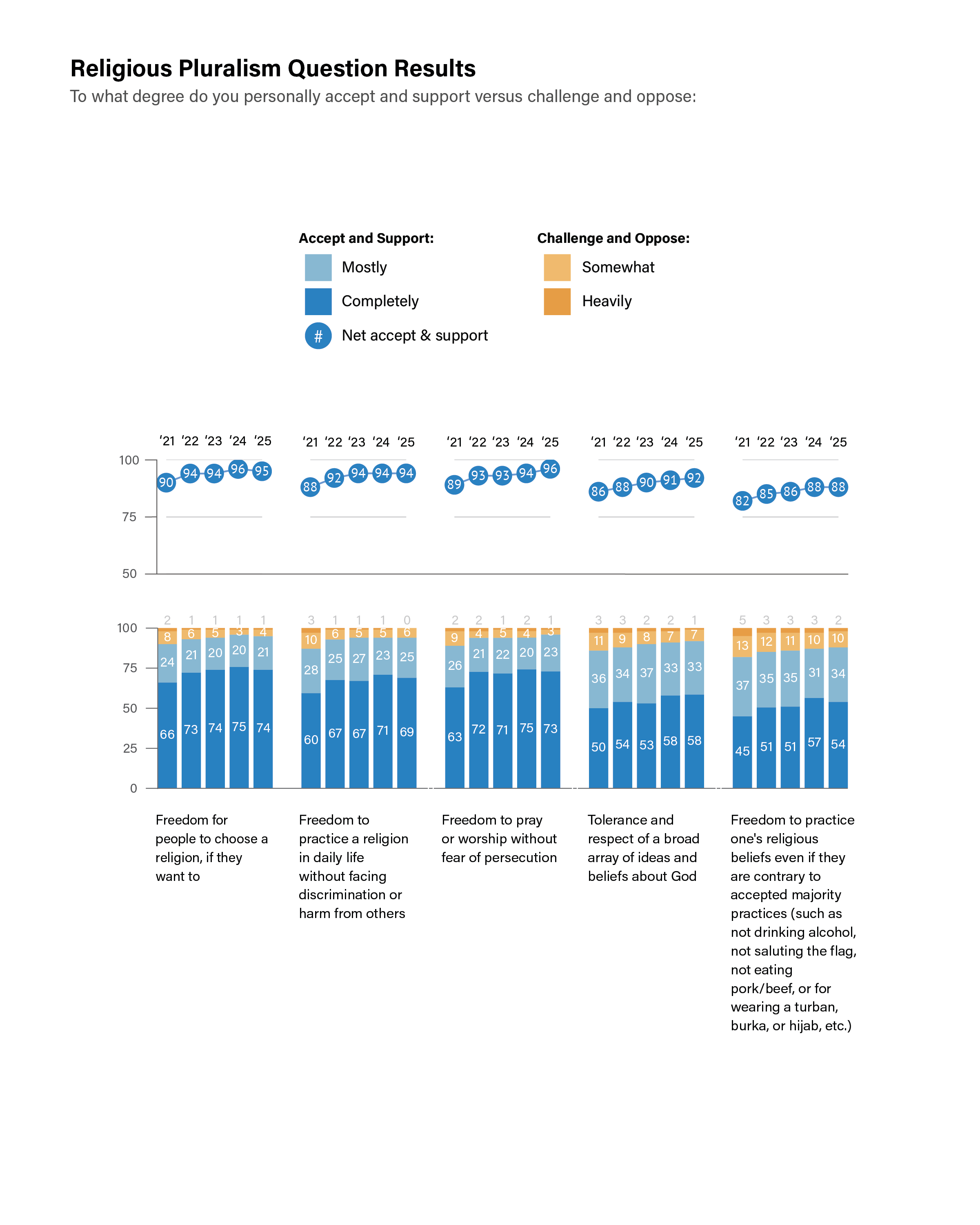
Religious Pluralism is one of America’s cornerstone values, and this year’s score – tied with last year’s for an all-time high – indicates a healthy level of support for Religious Pluralism, and that the higher levels of support the Index has tracked in this dimension – up from a low of 77 in 2020 – are here to stay.
In past years, we noted that as younger adults – Gen Z – became a larger share of the American populace, support for pluralism might continue to rise given Gen Z’s commitment to pluralism. Last year, Gen Z scored slightly higher than Americans overall on this dimension (87). This year, Gen Z actually scored slightly lower (85, the same as Millennials, who scored 4 points lower than Gen Z last year) but slightly less than Gen X and Boomers, who scored 86, in line with Americans as a whole. This minor decline does not necessarily indicate that the trendline will reverse and that we can expect declining scores in the future, but it might indicate that support for Religious Pluralism will level off after last year’s high-water mark. (Of note, in this year’s Index we do not discuss the Silent Generation due to the very small sample size of that generation in our nationally representative poll.)
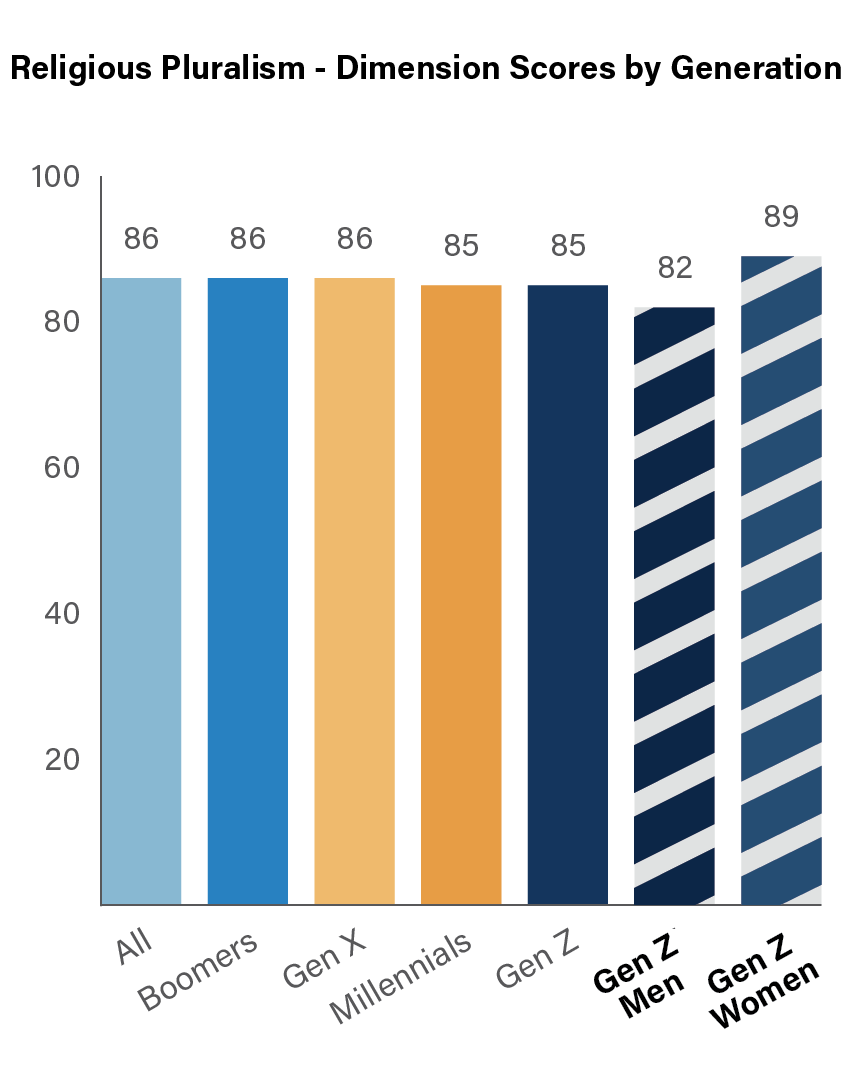
Perhaps even more interesting are the internal dynamics within Gen Z. Gen Z women scored an 89 on this dimension (roughly in line with last year’s score of 90), but Gen Z men scored only an 82, a drop from last year’s score of 84. This 7-point dimension gap is the largest observed within Gen Z except for the one in Religion in Action. Caution should be used due to the relatively small sample sizes at play, but this is one of a number of differences we have noted between Gen Z men and women in this year’s results, and is in line with the difference in scores on the Index as a whole: Gen Z men scored a 69 – 2 points below Americans as a whole – while Gen Z women scored a 72, slightly higher than Americans as a whole.
Other polling has suggested that Gen Z males are increasingly turning to religion or are growing more conservative. Although they need to be taken with caution given the small sample sizes, our results do bear this out somewhat: 40% of Gen Z men identified as conservative, compared to 34% last year. Interestingly a drop was also observed for Gen Z women, from 33% in 2024 to 27% this year, with Gen Z men identifying as “very conservative” rising from 6% to 10%; meanwhile, only 6% of Gen Z women identified as “very conservative,” down from 15% last year. Reported religious attendance rose for Gen Z year-over-year, from 40% saying they attended at least monthly in 2024 to 47% in 2025. Bearing out other reporting, we also found that the rise among Gen Z men who reported attending at least monthly (51%, up from 43% in 2024) was higher than Gen Z women (42%, up from 40% in 2024). With our modest sample sizes, these specific year over year changes for Gen Z men and women are not statistically significant, but it is interesting in light of other polling suggesting similar dynamics.
Our results also show that conservative and liberal Americans have much more similar scores in this dimension (86 for conservatives, 88 for liberals, or, by party affiliation, 86 for Republicans and 87 for Democrats), and all higher than Gen Z men. If anything, the results of Gen Z men in this dimension are closer to those of those who identified as political independents (85) or moderates (83, still higher than the 82 registered by Gen Z men). Similarly, it seems unlikely that the relatively low scores of Gen Z men are due to increased religiosity: weekly religious attenders scored 90 on this dimension, and almost weekly attenders 87. Male Gen Z’s results were more in line with those who reported attending about once a month (81), which is, interestingly, lower than those who report attending seldom or never (86). Thus, Gen Z men’s lower score in this dimension is not because Gen Z men are conforming their beliefs about Religious Pluralism to the views of most American conservatives or imitating those who attend religious services faithfully.
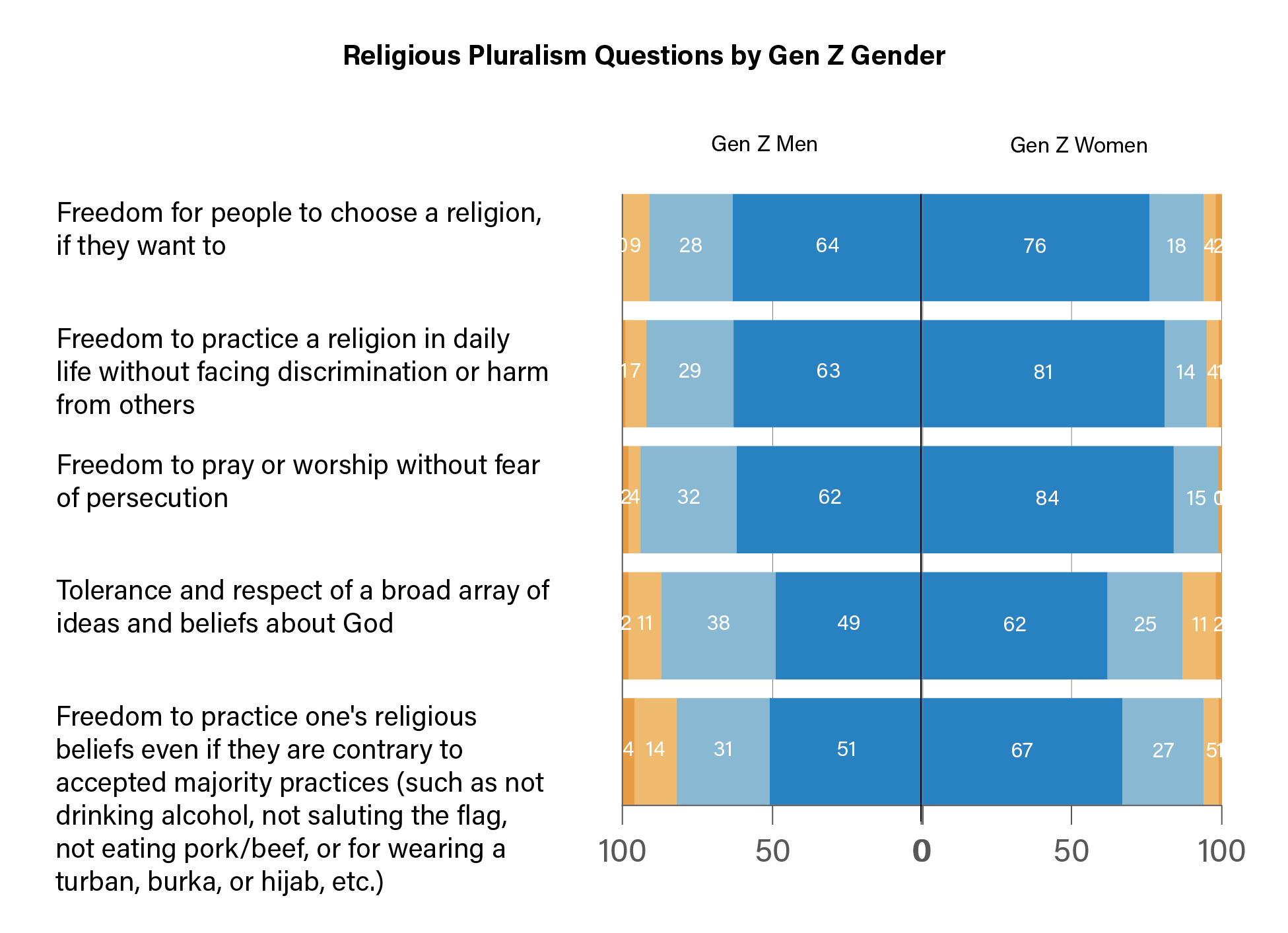
Gen Z males were least comfortable with the freedom to practice one’s religion even if it inconveniences others, with less than a third (32%) registering complete acceptance and support and a third (33%) opposing it in some way, compared to only 26% opposition and 45% complete acceptance and support from Gen Z women. This enthusiasm gap showed up even on questions where the overall support was identical: Gen Z men and women showed the same amount of support (87%) of tolerance for a broad array of beliefs about God, but 62% of Gen Z women accepted and supported this completely, compared to less than half (49%) of Gen Z men.
Although the Gen Z split is a concerning one that we will continue to track in future editions of this Index, the results as a whole are positive: Americans overwhelmingly support Religious Pluralism, more so than the other dimensions of religious freedom that we examine. Moreover, this high support for religious pluralism may be behind the strong support for religious plaintiffs in cases such as Mahmoud v. Taylor, where religious families of several different faiths requested opt-outs from public school curriculum for religious reasons. These sorts of accommodations are necessary for religious coexistence in a pluralistic society, and, as discussed below in the Key Takeaways section, Americans tend to come out swinging in their favor.
Religion and Policy
The Religion and Policy dimension covers a wide range of religious practice and belief. It asks about the interactions of government, private organizations, and individuals with religion. Many of the questions in this dimension relate to current religious freedom debates.
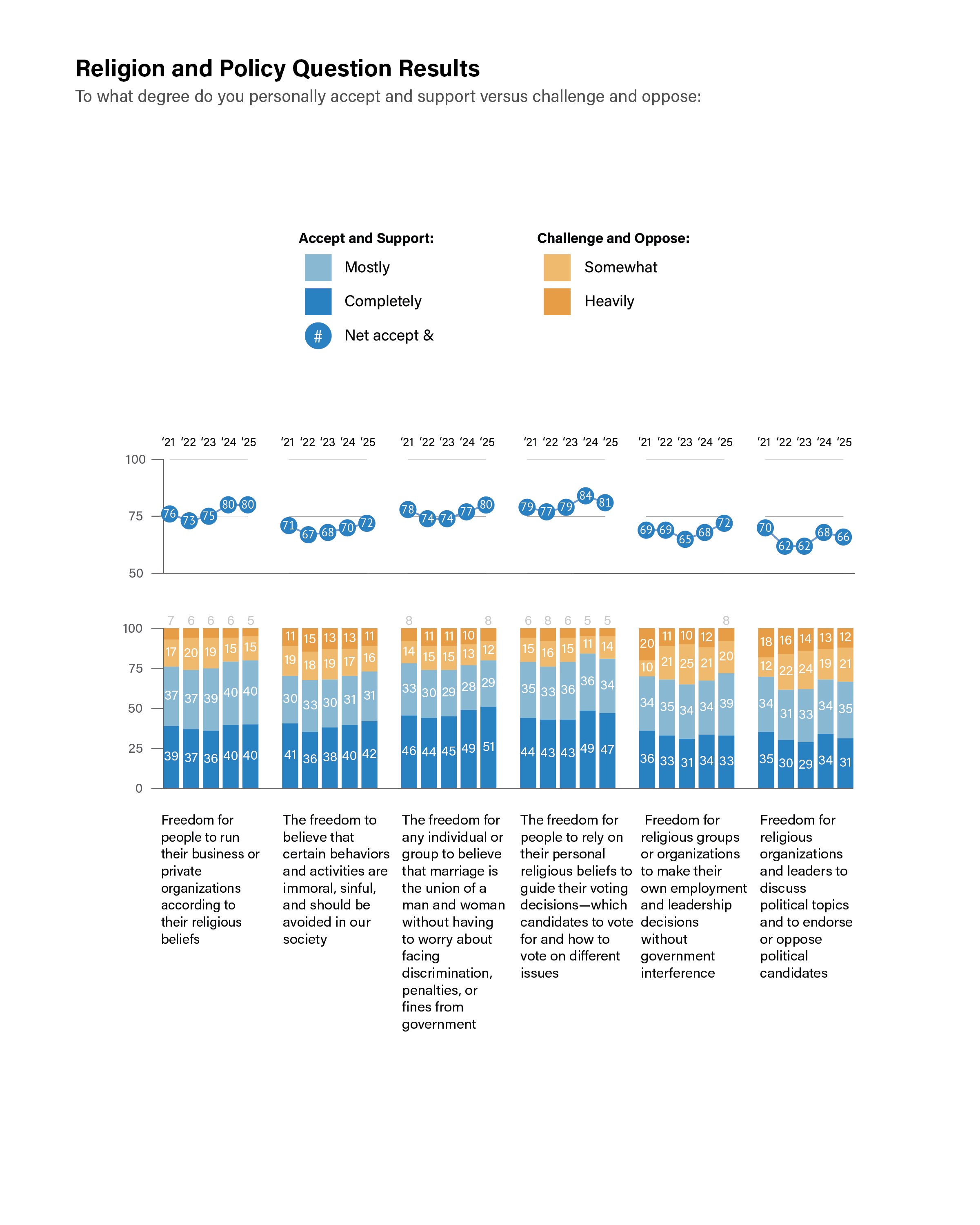
The Religion and Policy dimension offers a look at how Americans view the crossroads of the law and religious belief. Although Americans overwhelmingly support the ability to choose one’s own religious beliefs in theory, in practice the ability to live out those beliefs can be challenged by government regulation. While this intersection can generate intense controversy, Religion and Policy has remained relatively steady over the years. This year, the score for this dimension rose from last year’s 68 to 69, an all-time high for the dimension.
Despite the often-politicized nature of the questions in this dimension, Democrats (62), independents (69) and Republicans (78), liberals (58), moderates (71) and conservatives (78) all scored above a 50. It is interesting to note that self-identified Democrats scored higher than self-identified liberals, while Republicans and conservatives score the same. This is likely due in large part to the influence of black Americans, who are the most likely racial group to self-identify as Democrat (47%) and scored the highest of any racial group on this dimension (73). Although this dimension is more polarizing than Pluralism, these numbers still indicate that, on the whole, Americans of all stripes at least somewhat support religious freedom in this dimension, making religious freedom a potential unifier in today’s often divisive political culture.
Generationally, Boomers (71), Gen X (70) and Millennials (69) all scored similarly, with a slight but noticeable drop-off with Gen Z (66). However, a closer look shows that Gen Z’s low score is being driven by Gen Z women, who score 64, 4 points lower than Gen Z men. This is an interesting reversal, as Gen Z women score slightly higher on the Index than Gen Z men do, and much higher in the dimensions of Religious Pluralism and Religion in Action.
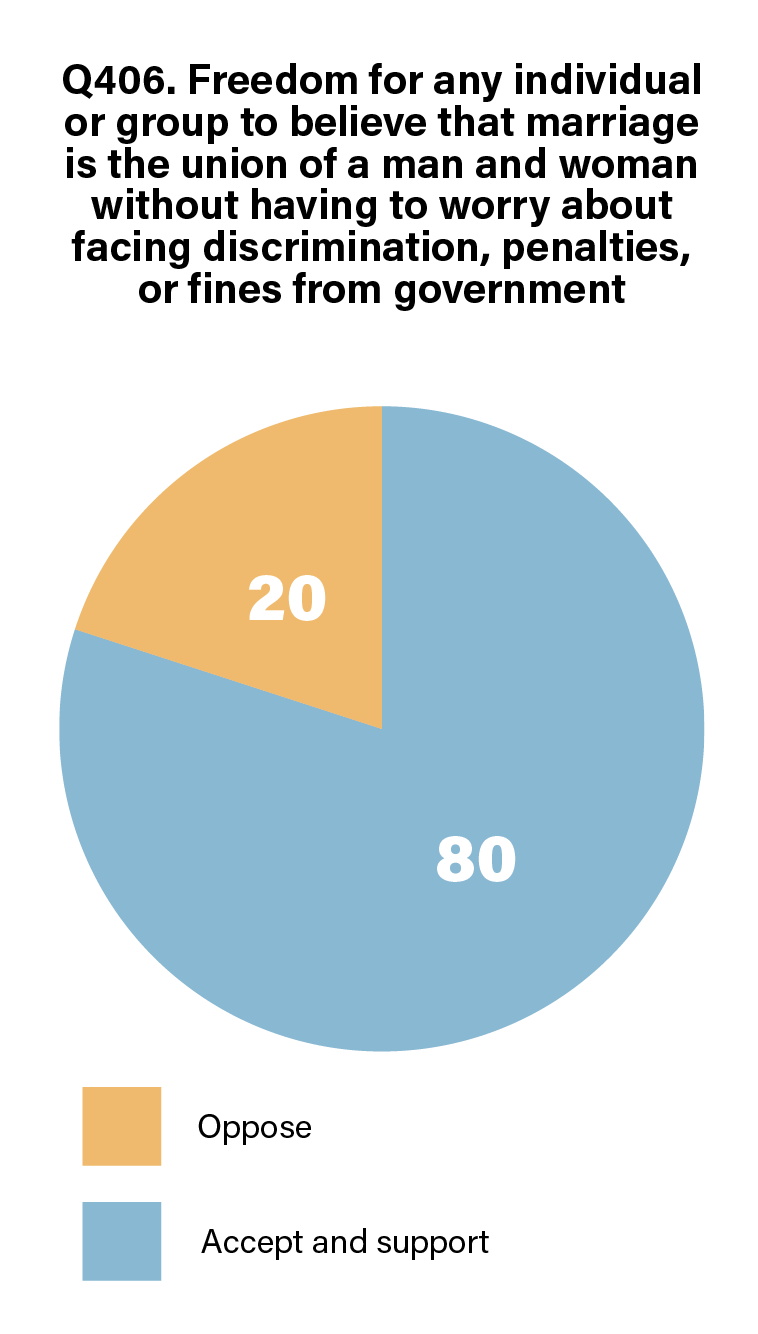
One particularly interesting finding is that 80% of Americans completely or mostly accept and support the freedom for any individual or group to believe that marriage is the union of a man and a woman without facing fines, discrimination, or penalties from the government. This is the highest level of support on record, 3 points higher than in 2024. Interestingly, this was a point of division among Gen Z, with 68% of Gen Z women and 84% of Gen Z men saying that it was at least somewhat important part of what should be protected and included in religious freedom. Despite the division, it is also worth noting that strong support (“completely accept and support”) among Gen Z for this freedom is still up 13 points since 2020. The fact that a strong majority of Gen Z accept and support this is heartening news for the future.
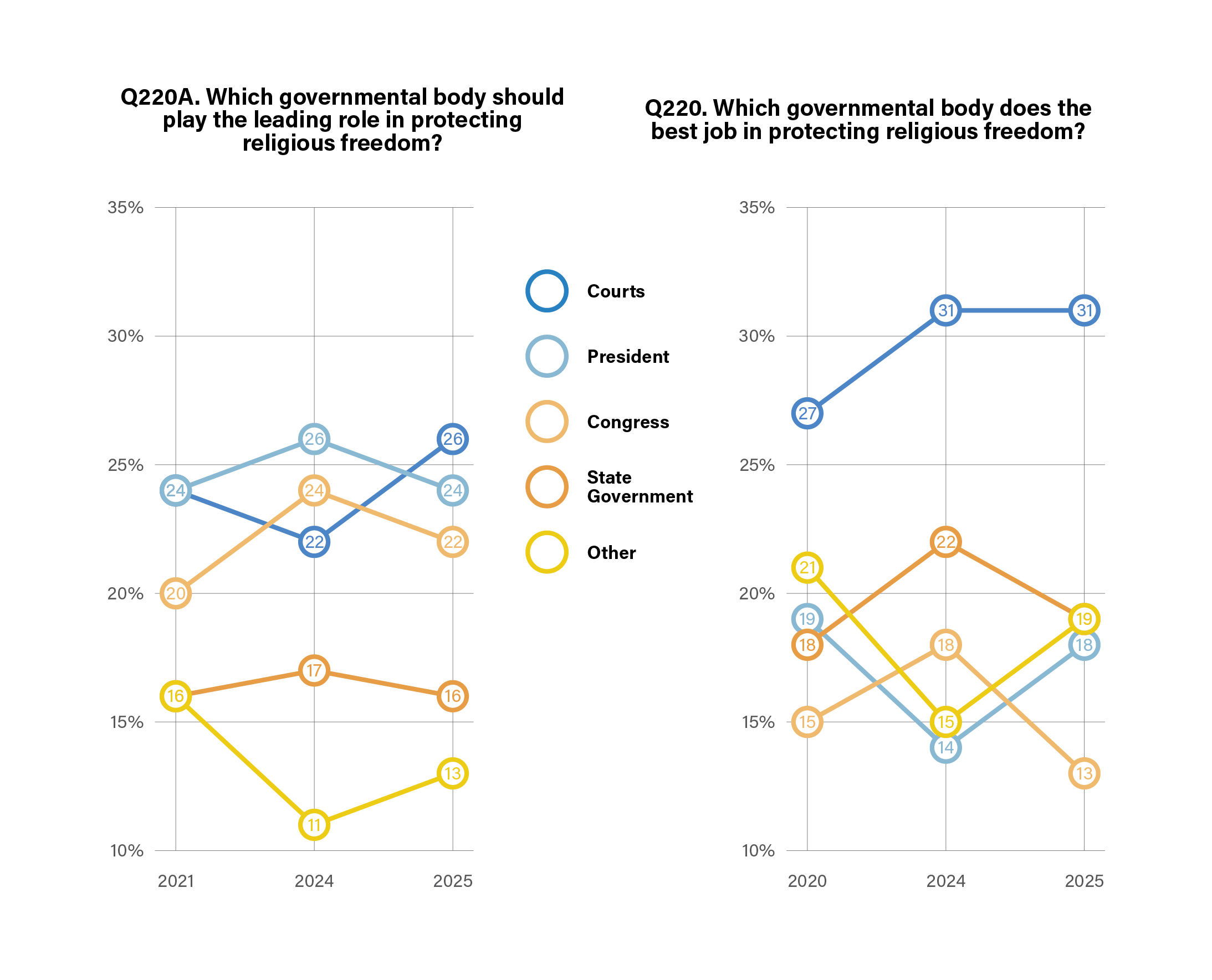
An important aspect of policy is the policymakers. This year’s Index found that Americans were closely divided when asked whether or not they trusted the Supreme Court to arrive at the right decision, but we also found that people of faith were more trusting when religious freedom specifically was the issue before the Court. We also asked which governmental body should play the leading role in protecting religious freedom. A plurality (26%) chose the courts, up 4 points from 2024. 24% chose the President, and 22% Congress, each down 2 points from last year. 16% and 13% chose state governments and “other,” respectively, roughly in line with last year’s findings.
When asked who does the best job in protecting religious freedom, however, the changes since 2024 were larger: Congress dropped from 18% to 13%, swapping places with the presidency, which moved from 14% to 18%. State governments dropped from 22% to 19%, while the courts held steady with plurality support at 31%, the same as in last year’s Index. Although the courts remained the favorite, the increasing support for the Presidency is interesting and may stem from last year’s election of President Trump, as this year’s 18% mirrors the 19% support for the presidency that was recorded during President Trump’s prior term in 2020.
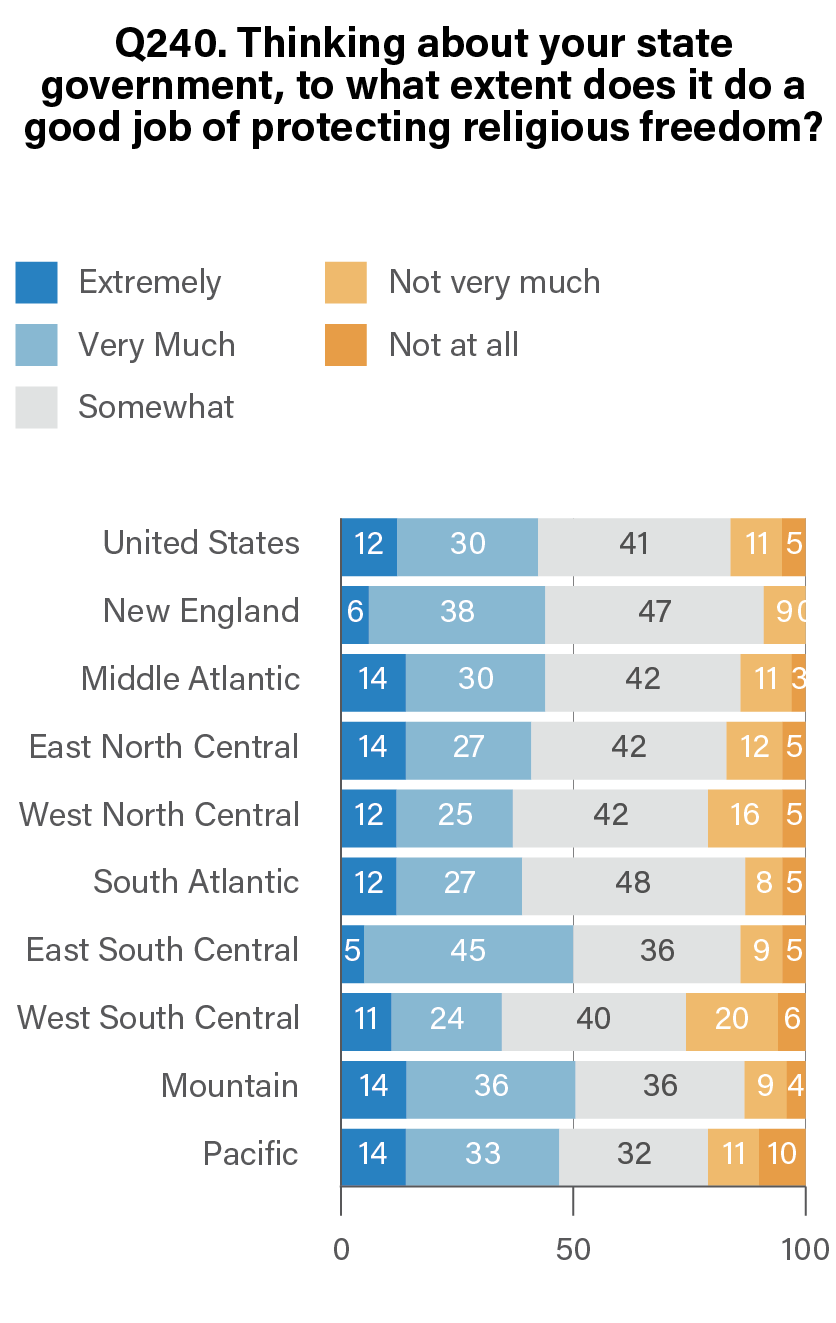
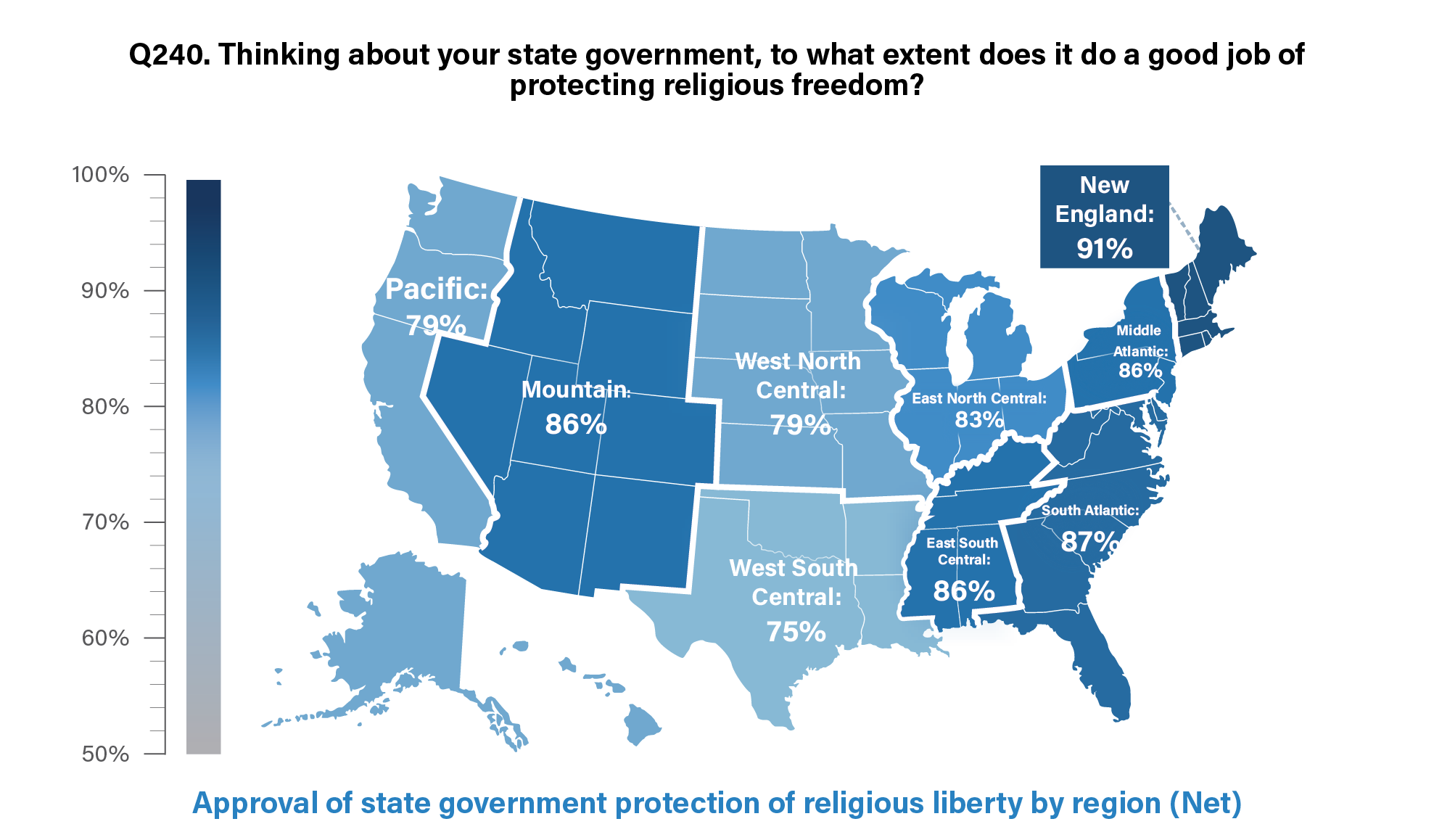
We also asked Americans to rate their own state’s performance on protecting religious liberty. Although our data size is too small to meaningfully evaluate individual states, we can assess the states according to the U.S. Census Bureau’s regional divisions of the United States. We found that the region of New England had the highest number of respondents who said that their state government does at least somewhat of a good job protecting religious freedom (91%). However, the Mountain and East South Central regions recorded higher levels of intensity: 50% of respondents in each region indicated responded “very much” or “extremely” when asked to what extent their state government did a good job protecting religious freedom. West South Central scored worst on both accounts, with only 35% responding “very much” or “extremely” and 40% agreeing their state did a “somewhat” good job protecting religious freedom.
Americans were relatively divided on a question of whether or not religious leaders should endorse candidates for office, with 50% saying that it was absolutely essential or at least an important part of religious freedom and 57% completely or mostly accepting and supporting the practice. Given the support we have seen for religion in the public square in this year’s results, it is not surprising that most Americans support the ability of religious leaders to comment on politics, even to the point of endorsing candidates. However, another question we asked this year about the Johnson Amendment – a provision of the U.S. tax code named after Lyndon B. Johnson, who introduced it as a senator and would go on to become President. This provision specified that nonprofits – including churches – would not be allowed to endorse political candidates for office while keeping their tax-exempt status. This year, the IRS announced that they would not enforce this provision as applied to churches. However, only 46% of Americans supported this decision, although among those most likely to be directly affected – weekly churchgoers – support was 22 points higher.
This response could suggest that Americans have troubling limitations on their conception of religious freedom, especially when it comes to the ability of churches to make their own decisions. Policies that punish churches for free speech (even political speech) are straightforwardly bad for religious freedom. Yet we’ve seen again and again that Americans prefer individuals to institutions, and our findings that Americans seem more optimistic about people of faith than religion might be reflected here with a poor opinion of churches’ ability to exercise their rights to expression and self-organization without government interference.
On the other hand, it may simply reflect subpar civic education and a lack of public dialogue around these questions. (See, for instance, our 2022 Index, where only 47% of respondents correctly identified freedom of religion as being protected by the First Amendment.) We know from other questions that Americans typically oppose government interference in religious organizations. For instance, to refer to another question from this dimension, 69% of Americans think that the freedom for religious organizations to make their own employment and leadership decisions without government interference is either an absolutely essential or important part of religious freedom, and 72% of Americans completely or mostly support it. Thus, it seems likely that Americans’ opinions on these questions might shift if they better understood the stakes. Future editions of the Index may explore these topics in more detail to better understand Americans’ beliefs on this topic.
On the whole, the rising scores in this dimension are a positive sign for religion and policy. This year’s results suggest that even amid contentious policy debates, religion – and religious freedom – tend, more often than not, to be something that unifies Americans rather than divides us.
Religious Sharing
The Religious Sharing dimension considers the exchange of religious ideas in the public square. Closely tied to freedom of speech, this dimension provides insights into unique aspects of communication in American society.
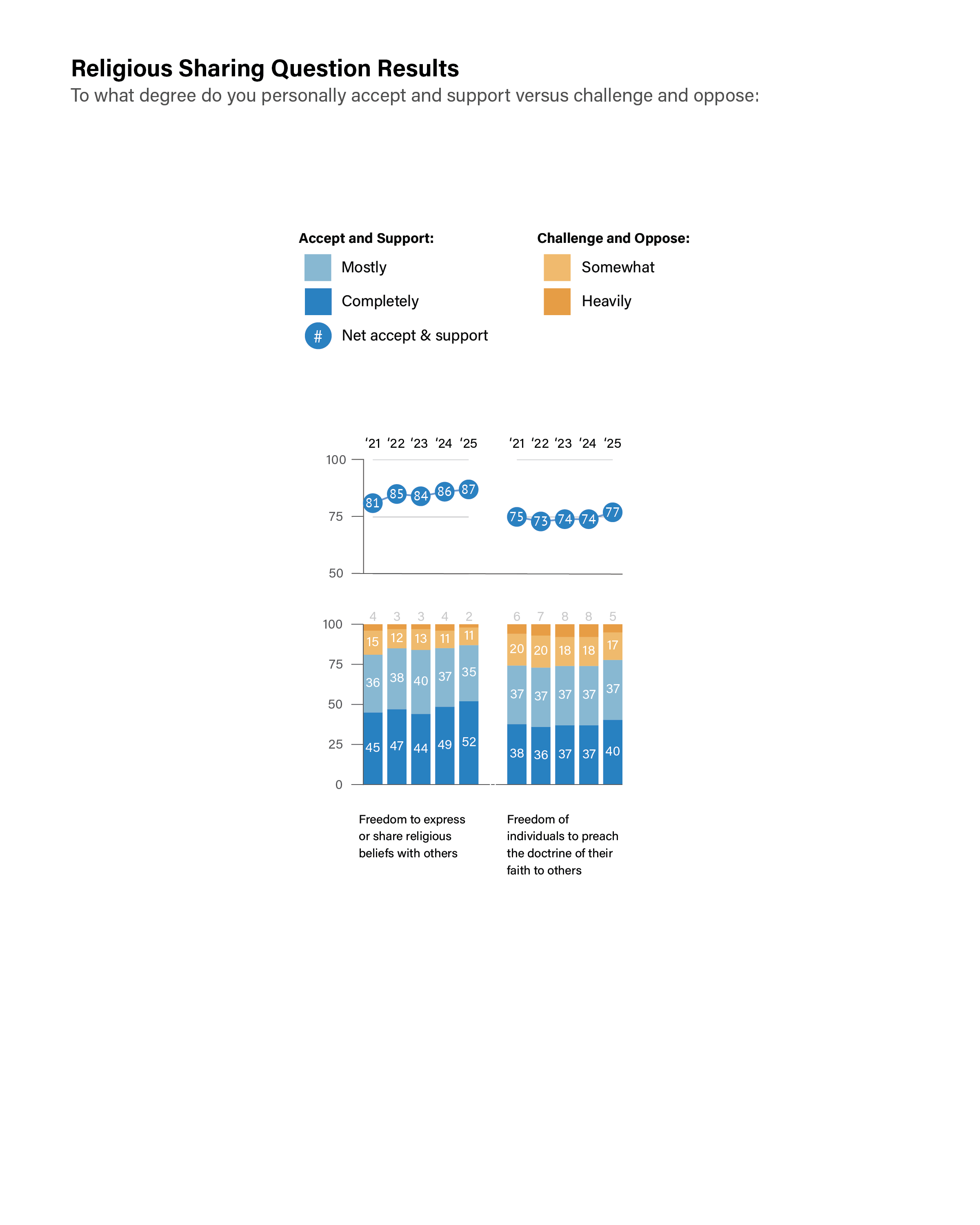
The Religious Sharing dimension measures support for the right of religious expression through sharing one’s religious beliefs or preaching to others – a cornerstone of religious liberty that is protected by both the Free Speech and Free Exercise clauses of the First Amendment. This year, Religious Sharing saw the most dramatic rise out of all the dimensions, increasing by 3 points to a new high of 75. This notable jump in support for Religious Sharing was a driving factor in the increase of the Index’s new high score.
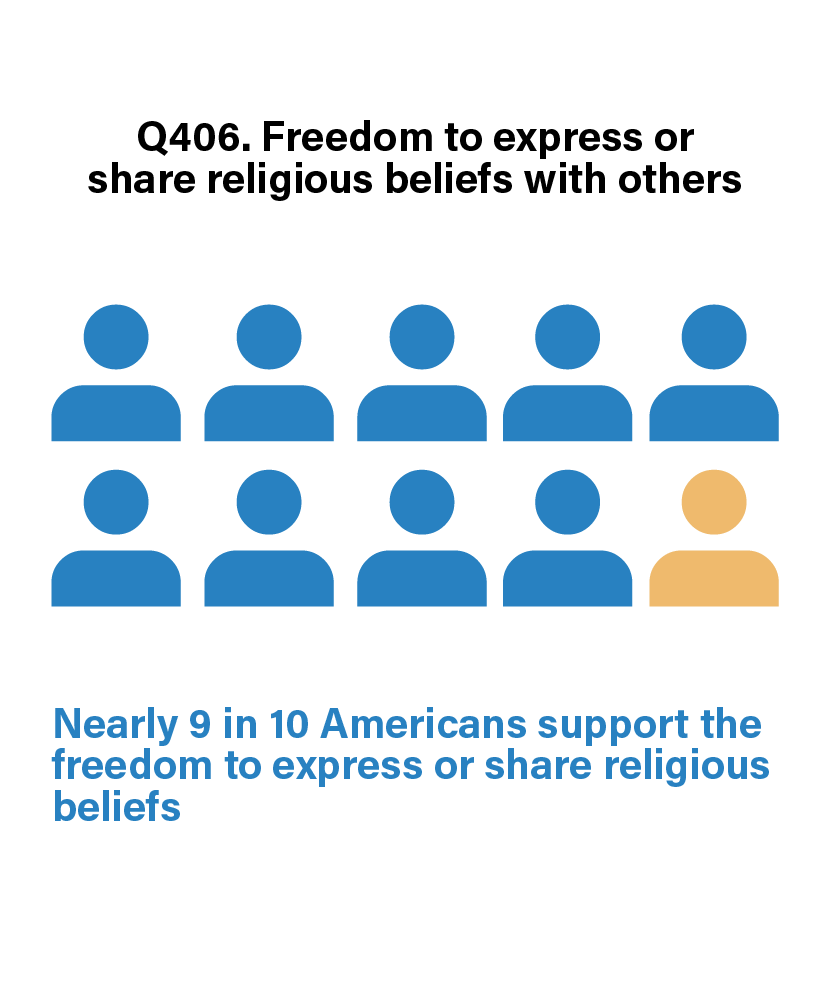
The Religious Sharing dimension has steadily maintained a score of 72 for the last three years, suggesting that this year’s jump measures an authentic shift in American attitudes toward religious expression in the last twelve months. Notably, this year’s Index not only saw an increase in broad support for religious expression, but also captured the growth of intensity in Americans’ support for such freedoms. For example, 87% of Americans said that the “freedom to express or share religious beliefs with others” is an important part of religious freedom, a strong majority with a 1 point increase from last year. The percentage of Americans who consider this same freedom to be an absolutely essential part of religious freedom rose by 4 points to 56%, a new high score for this item. Likewise, when asked for their personal views on this freedom, a similar 3 point increase was measured in respondents who said they completely accept and support it (52%), the strongest marker of support (net support also grew by 1 point to 87%).
The “freedom of individuals to preach the doctrine of their faith to others,” despite typically being less popular than the freedom to express or share religious beliefs, also saw new intensity of support this year. The share of Americans who consider the freedom to preach to be an absolutely essential part of religious freedom jumped to 40% of respondents, up by 4 points from 2024’s 36%. This was echoed in Americans’ personal support: 77% of respondents said they at least mostly accept and support this freedom, a 3 point increase from last year’s 74%, driven by the equivalent jump in those expressing complete acceptance and support (40%, up 3 points).
In a continuation of last year’s findings, Gen Z is the most supportive generation of Religious Sharing, scoring 78, 3 points above the total average score. Gen Z has marked a steady upwards trend line in Religious Sharing over the last several years, going from below average support in 2022, to in-line with the average in 2023, to 3 points above the average in 2024. With this year’s continued increase, Gen Z’s complete support for the dimension is up 12 points from 2020’s low. Gen Z’s support for Religious Sharing is driven by its share who completely accept and support the freedom to express or share religious beliefs with others (60%), which is 8 points higher than all Americans’ (52%). However, Gen Z is less accepting of the freedom of individuals to preach the doctrine of their faith to others, with 43% saying they completely support this. Although Gen Z is still above average in their highest level of support for preaching, this 17-point difference between Gen Z’s support for sharing and that for preaching is the widest gap of any generation.
Gen Z’s aversion to “preaching” as opposed to “expressing and sharing” one’s faith makes for an interesting divergence in year-by-year data. While Gen Z’s complete support for the freedom to share one’s faith has grown significantly since 2020, their complete support for the freedom to preach one’s faith to others has remained more idle around the 40% to 43% range since 2019, with the exception of 2020, when it dropped to 32%.
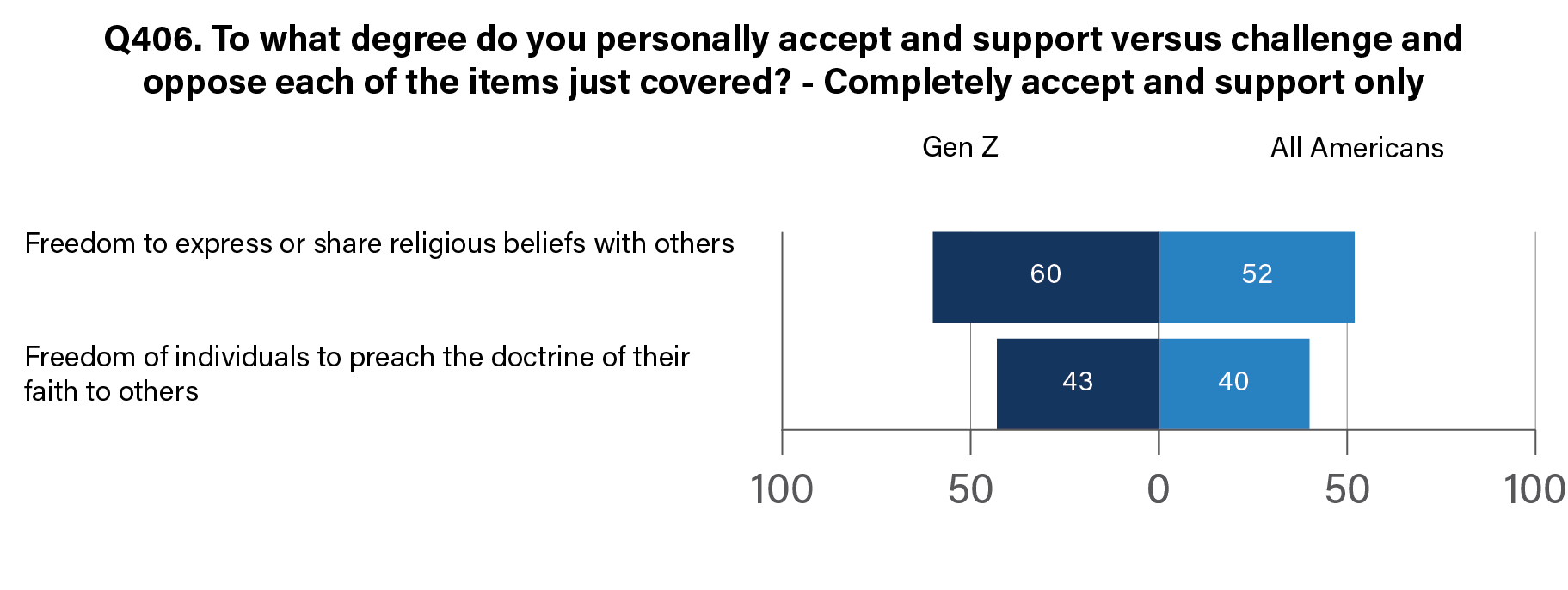
Like past years, this year’s Index found people of faith are more likely to support religious sharing, alongside those who are members of a religious institution, consider religion to be extremely or very important, or who attend a religious institution weekly scoring well above the mean support. LGBT+ people of faith also scored 5 points above the mean, scoring 80 in Religious Sharing, and 15 points over LGBT+ respondents who were not people of faith (65). Another gap is seen between respondents with people of faith in their social circle and those without: Americans without people of faith in their social circle scored 62, whereas respondents who are not a person of faith but do have people of faith in their social circle scored 6 points higher, 68. These encouraging findings confirm that when Americans have personal relationships with people of faith, whether in their families or in their communities, they are more likely to support the freedom to express their religious beliefs.
Religion in Society
The Religion in Society dimension directly asks respondents to evaluate the contributions of religion and people of faith to society. It gives context to religious participation in civil society.
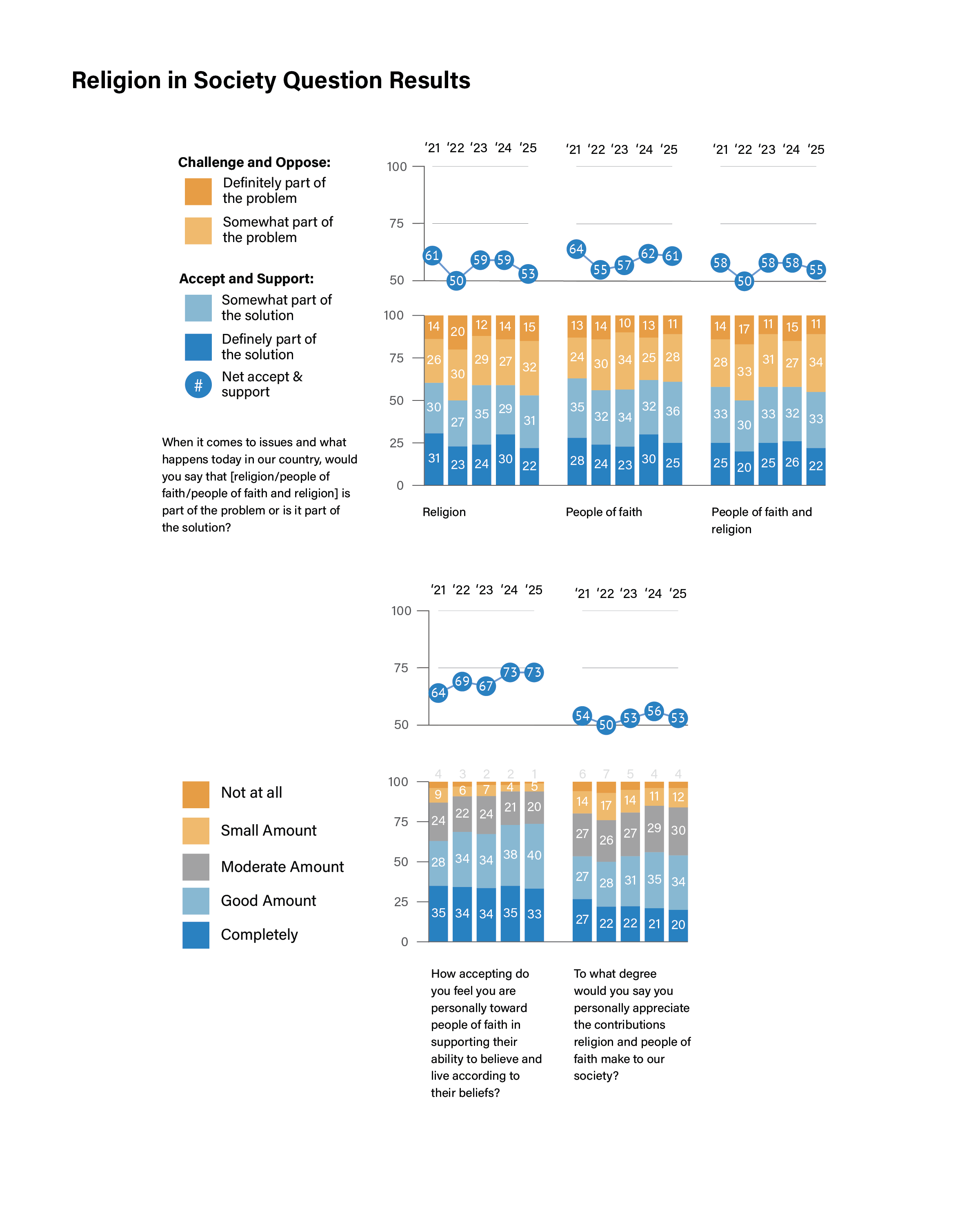
Religion in Society measures the attitudes of Americans toward religion. Although it does not ask about any specific legal policies or guaranteed rights, it asks about what is perhaps the most fundamental question of all: is religion valued in our culture? A society with no appreciation for religion ultimately will see its legal protections for religion fail, for the law will not protect that which a society does not treasure.
This year, our score on this dimension declined slightly, from 67 to 65. This still signals that, on the whole, Americans appreciate religion, but their confidence in it may have been shaken by recent events. Since last year, the majority of Americans who believe religion is part of the solution dropped by 6 points, to 53%. Last year, we discussed how a similar decline in 2022 from 2021 might have been tied to controversy over the Dobbs decision about abortion. This year’s decline could be due to lingering fallout from the 2024 presidential election (the polling in the 2024 Index was conducted before the 2024 presidential election took place) or other factors. These numbers have bounced back considerably since 2022, and analyzing the results in future years might allow us to better assess which specific issues drove this year’s downturn.
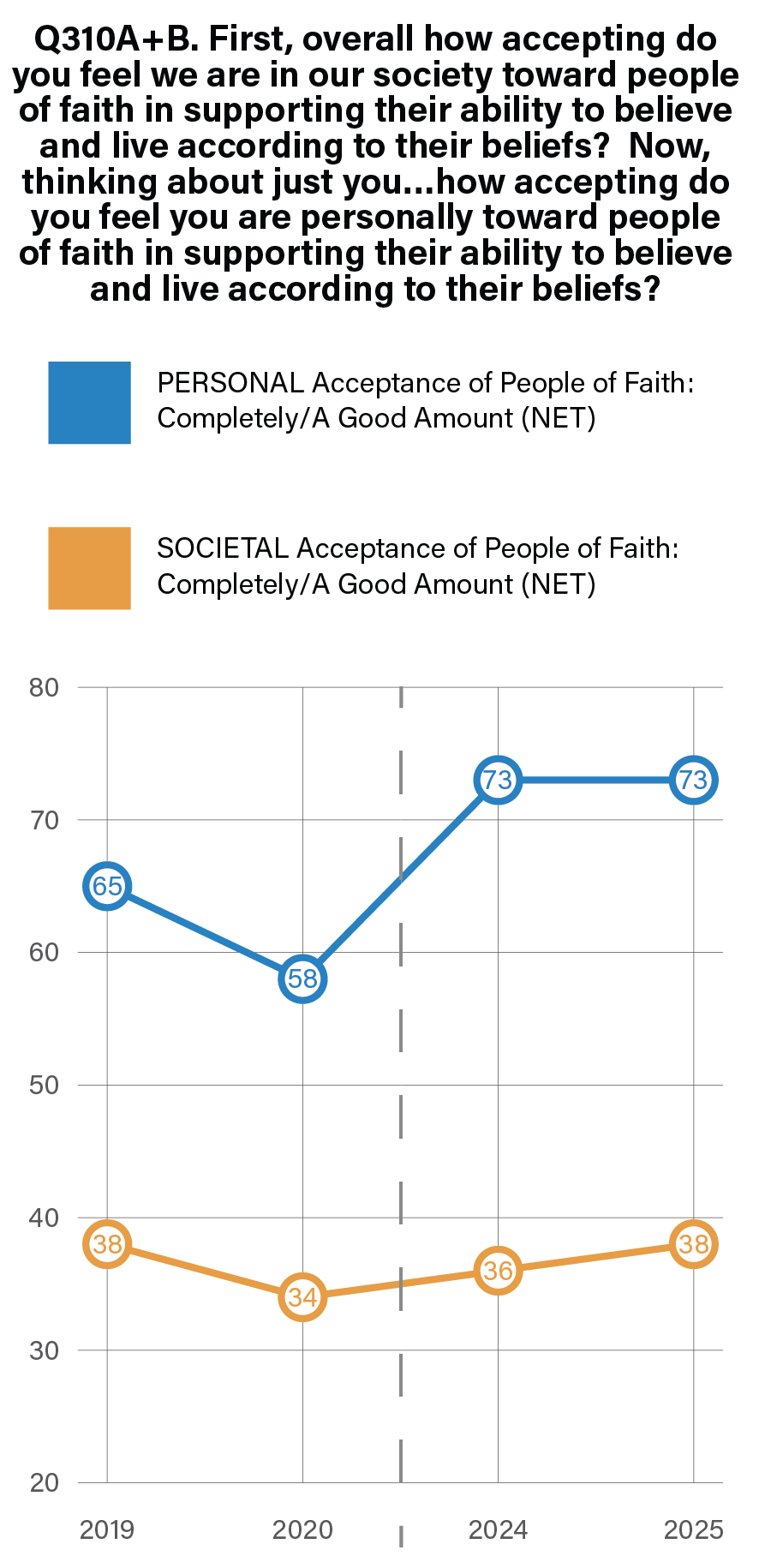
However, belief in people of faith being part of the solution scored 61%, notching just under last year’s score and 6 points over 2022’s all-time low of 55%. Higher levels of support for individual people of faith than for institutions is a trend reflected across the Index, and one likely rooted in American culture and attitudes. For example, 73% of Americans consider themselves completely or a good amount accepting toward people of faith and their ability to live according to their beliefs. This score remained stable from last year, and has risen nearly continuously in the last five years, up 15 points since 2020’s low.
A generational analysis of this question shows some interesting findings. First, Millennials are more likely than Gen Z or Boomers to say that religion is part of the solution, but less likely to say that people of faith are. Secondly, among Gen Z males and females, the question of whether people of faith are part of the solution may be more polarizing than the question of religion: 60% of Gen Z men describe people of faith as the solution, compared to 50% of Gen Z women. But on the question of whether religion is part of the problem or solution, Gen Z women’s opinion remains the same, while Gen Z men’s opinion drops by 15 points to below that of Gen Z women. It seems that Gen Z men, more so than women, are hostile to institutions, while much more confident in the goodness of individuals. As before, we offer these figures with the caveat that the small sample size in these split-sample questions renders these intra-generational differences statistically insignificant, but such a large gap might be indicative of real developments.
Americans continue to rate themselves as more accepting than broader society. While 73% of Americans consider themselves personally completely or a good amount accepting of people of faith, only 38% think society is accepting of people of faith to the same degree, although this number rose slightly from last year. By contrast, 58% of Americans think society is only a moderate or a small amount accepting of people of faith.
The difference in aggregate personal perception (most Americans are quite welcoming of religion) versus the perception of society suggests either that Americans are too cynical about their fellow citizens, or that they believe there are structural or cultural impediments to society’s full appreciation of faith and its benefits. Perhaps this concern is not entirely unwarranted: again and again, this Index has found that policies considered controversial are in fact supported by a majority of Americans. For instance, this year’s Index found that an overwhelming number of Americans – 71% – support protecting Native American sacred sites from copper mining. Despite this, both the Trump and Biden administrations pursued the destruction of Oak Flat, an Apache sacred site, after Congress enacted a law transferring the site to a foreign-owned mining company, and earlier this year the Supreme Court declined to hear Becket’s legal challenge to the transfer.
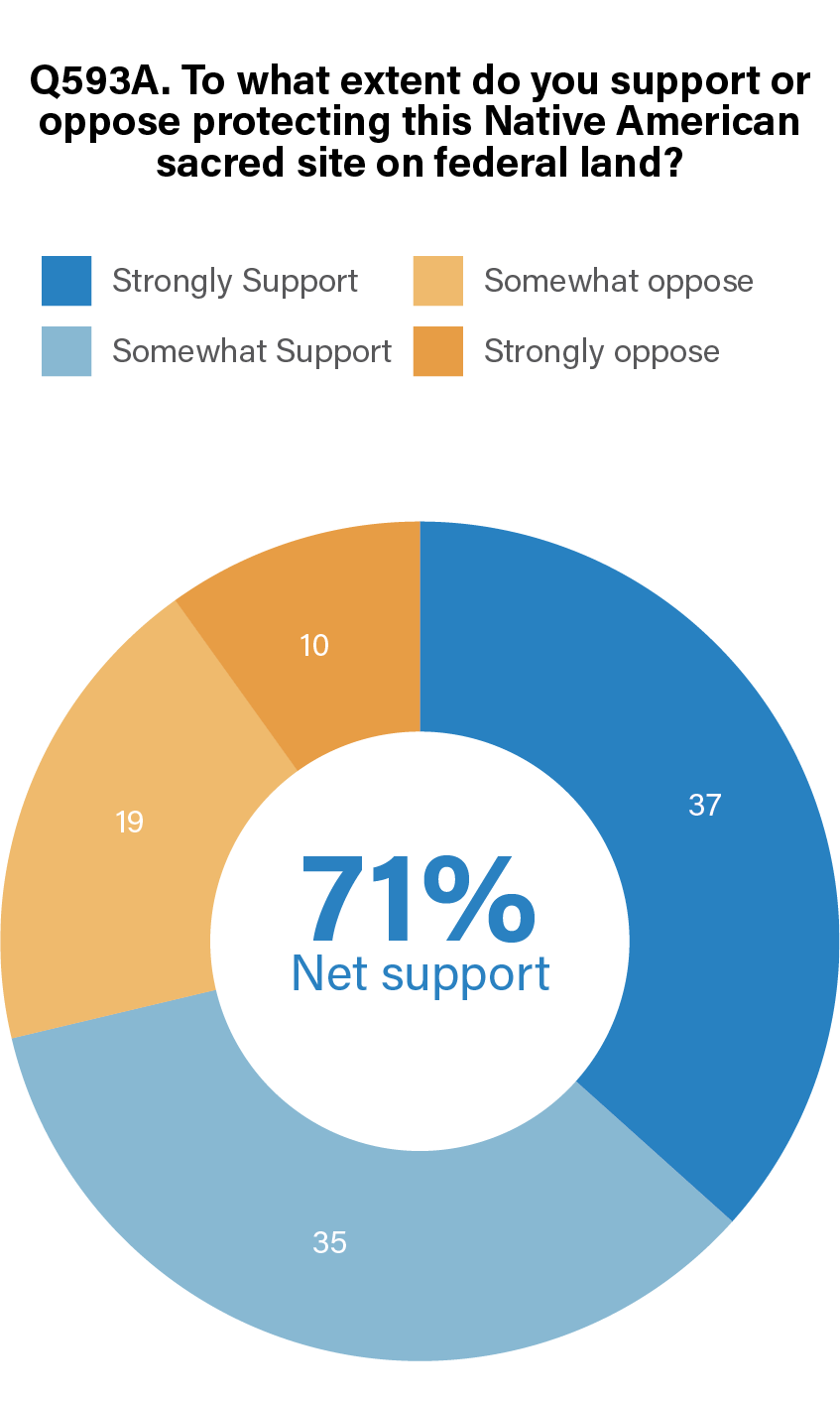
Despite the slight downturn in this dimension, the news is not all bad. This year, people of faith reported feeling about the same degree completely or a good amount accepted in society (53%, up 1 point from last year). The most notable positive change in this dimension was among Catholics, who were 5 points (59%) more likely than last year to report feeling completely or a good amount accepted in society. Perhaps this was because 2025 heralded the first American leader of the Catholic Church, Pope Leo XIV (born in Robert Prevost in Chicago, Illinois). Future editions of this Index will reveal whether or not this year’s slight downturn is the start of a longer trend of cooling attitudes toward religion or, as it has been in the case in the 3 4 3 5 past, a temporary dip before future growth. However, the fact that people of faith do not report a decline in their self-perceptions of being accepted in society gives us reason for optimism in this year’s results – whatever apprehensions about society the past year gave Americans, people of faith themselves seem not to have experienced any dramatic surge of mistreatment or disdain.
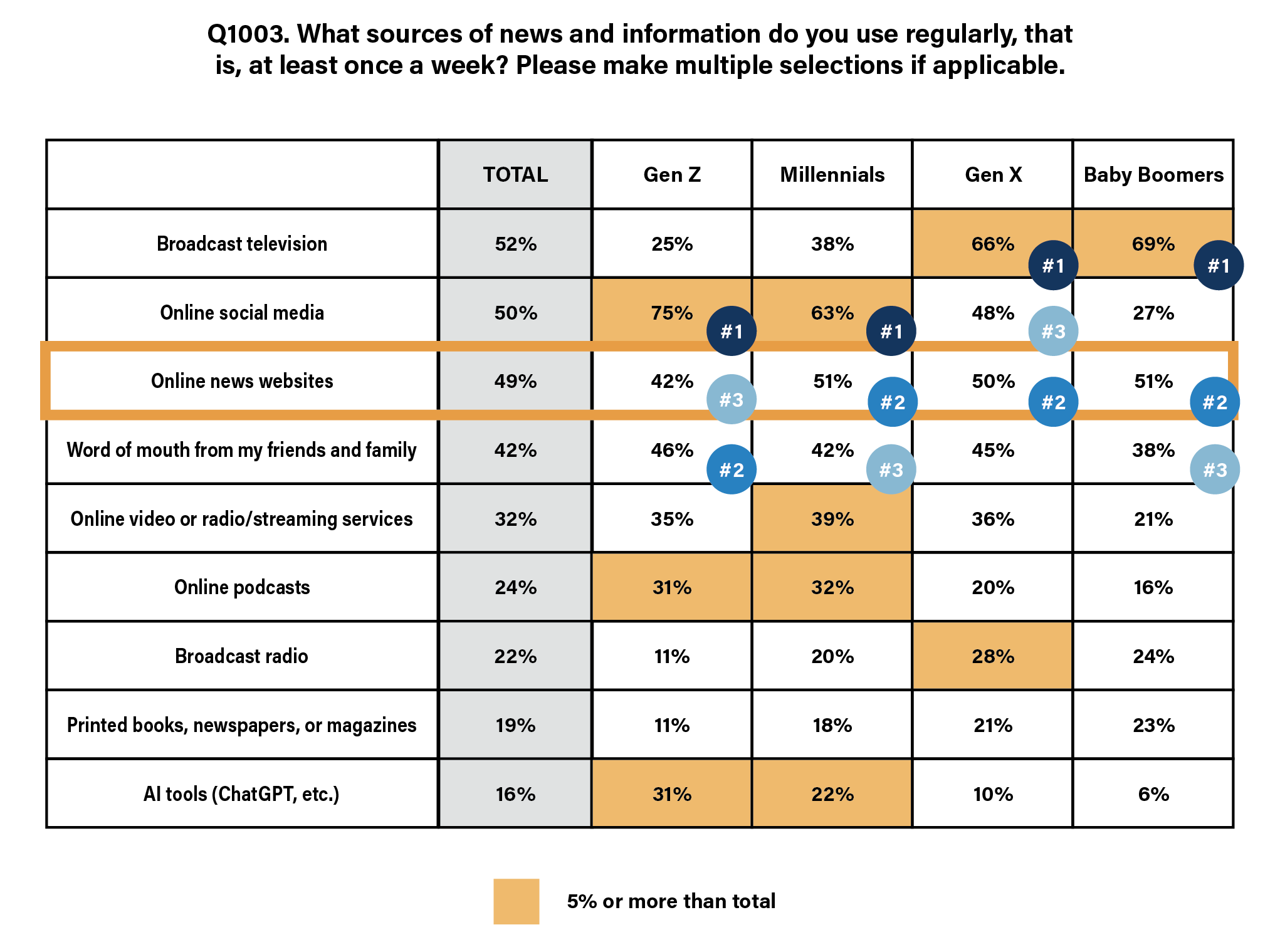
In light of the rising interest in artificial intelligence and large language models and the decline of traditional media, the Index also examined Americans’ media consumption, which is important to understanding generational gaps in attitudes toward religious freedom and changing opinions toward religion and people of faith. We found that, despite the attention paid to emerging technologies, a majority of Americans (52%) still watch broadcast television regularly. However, a generational analysis yields a more nuanced result, suggesting that online news websites may be the best medium for communicating with Americans of all generations, with around half (49%) of all Americans and at least 42% of each generation using online news regularly. 16% of Americans reported using AI tools such as ChatGPT – a small but notable percentage. However, only 5% of Americans reported trusting AI tools, with traditional media sources being overwhelmingly trusted (79%) over new media sources or social media – albeit less so (72%) when reporting on religious liberty specifically.
Church and State
The Church and State dimension surveys respondents about the interactions between government and religion. In asking about government funding and government speech, it draws out opinions on the Constitution’s Establishment Clause.
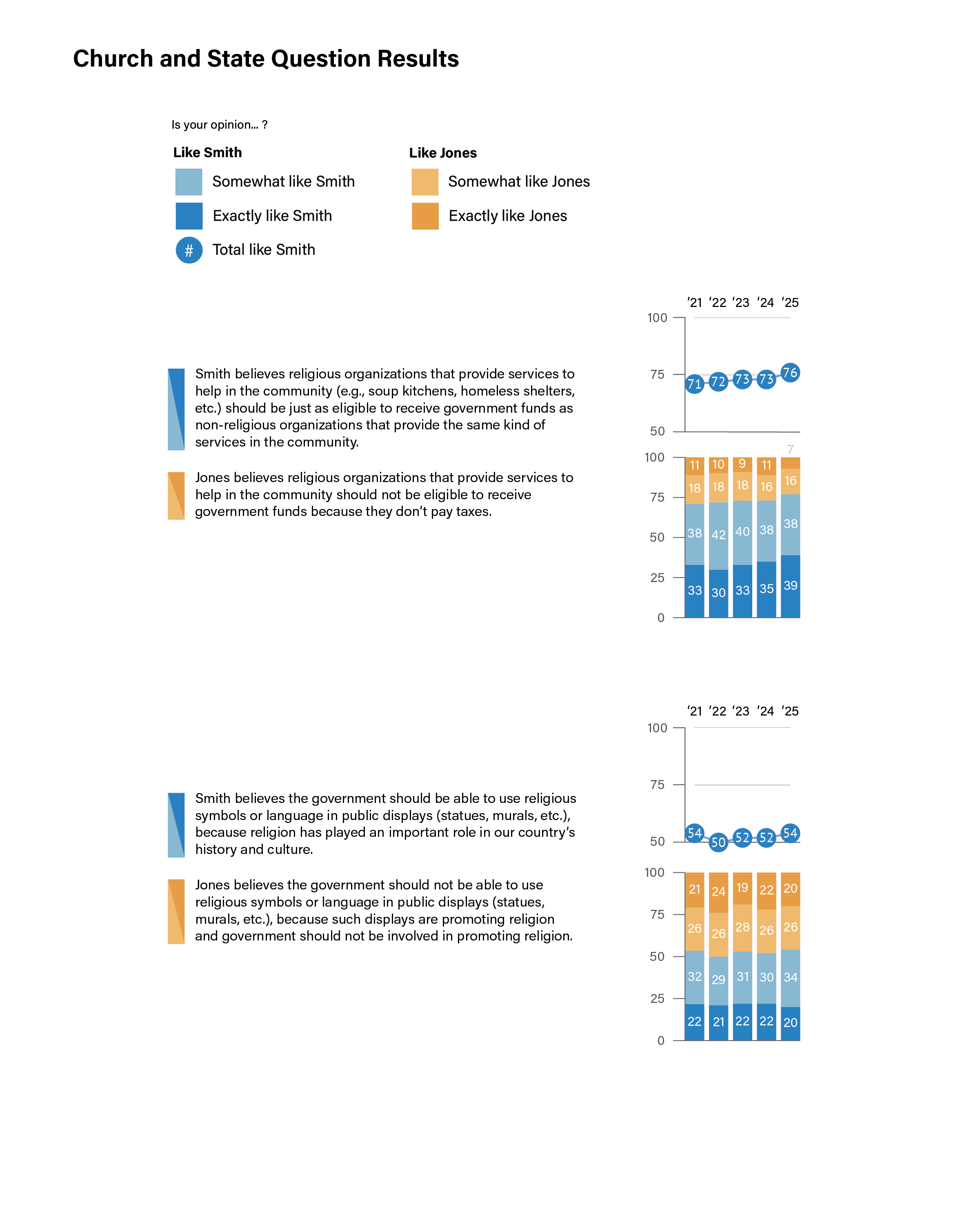
This year, the Church and State dimension, long the least popular dimension, finally rose to a score of 60. This dimension measures attitudes toward the government’s use of religious symbols and its role in financing religious charities and other organizations that provide aid and public services.
This year’s rise is mostly attributable to growing support for treating religious and non-religious organizations that provide community services equitably when it comes to government funding, with net support for this rising slightly from 73% last year to 76% this year. Interestingly, with 74% support for men and 73% support for women, this was an area where Gen Z expressed broad agreement. A similar question asked in this year’s Index found 79% support for “the US government partnering with religious charities to help those in need,” with 71% saying this was an absolutely essential or important part of what should be included and protected in religious freedom.
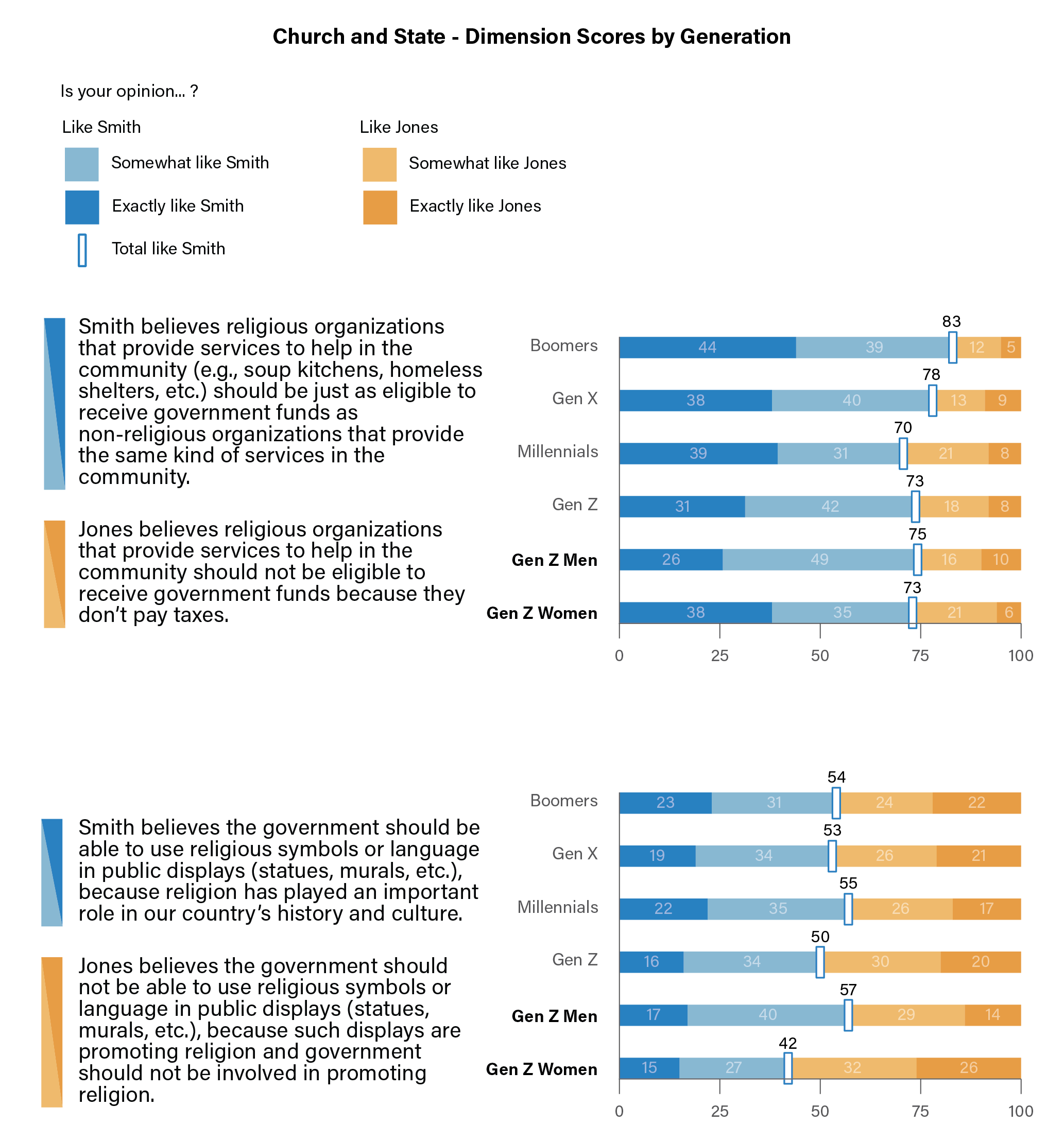
Support for government use of religious displays and symbols in public displays also rose slightly, from 52% to 54%. Gen Z was evenly split on this question, with a more pronounced gender divide: a majority of Gen Z men (57%) and a minority of Gen Z women (42%) were in support. Millennials (57%) had the highest amount of support.
American people of faith as a whole were more likely to support government use of religious displays and symbols, rising 10 points over average support to 64%. However, as we noted last year, the numbers are flipped for religious non-Christians, only 36% of whom support government use of religious displays in this year’s survey.
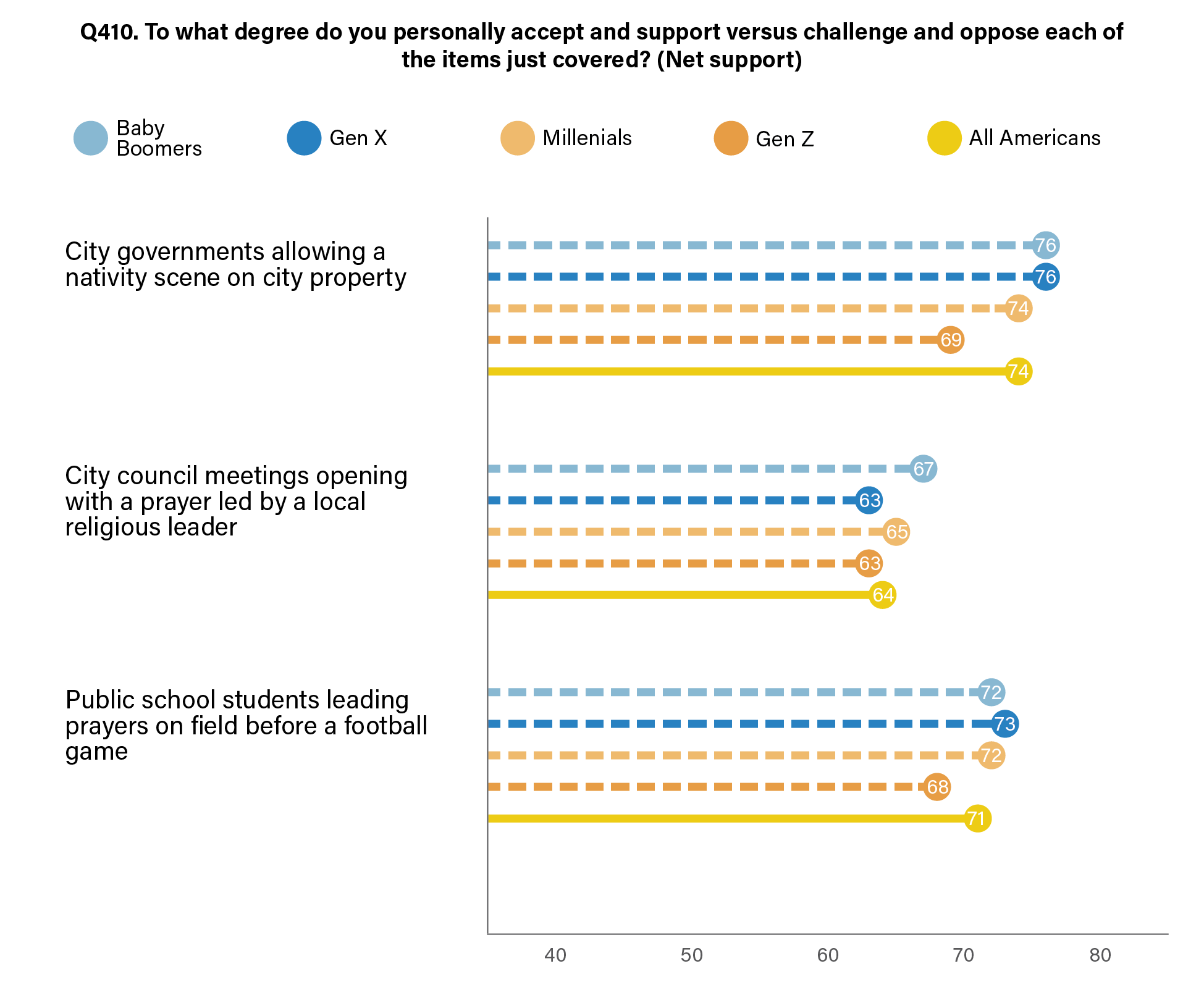
As mentioned elsewhere, Americans are also more likely to say that freedom of religion is inherently a public freedom, not a private one (57%, up 5 points since 2020). It is unsurprising, then, that with a growing awareness of the public nature of religious freedom and expression, there might be increase in support for public funding of public goods and even public displays of religious symbols. This year’s Index also asked about a specific scenario where a city government allowed a nativity scene on city property. Sixty-five percent of respondents said this was an absolutely essential or important part of what should be protected and included in religious freedom, and nearly three-quarters of Americans (74%) completely or mostly accepted and supported it, including over half (56%) of religious non-Christians.
In addition to questions about public religious displays, a pair of similar questions about public prayer were also asked. One question asked about opening city council meetings with prayer by a local religious leader; another asked about public school students leading prayer on the field before a football game. Although these sometimes lead to controversy and even lawsuits, a strong majority of Americans (64%) supported opening city council meetings with prayer, and an even greater majority (71%) supported students leading prayer on the football field. These numbers were relatively flat across generations, suggesting that support may not decline much or possibly at all as Gen Z becomes a larger share of the electorate. Two-thirds of Americans (66%) said that students leading prayer on a football field was at least an important part of religious freedom, and 58% said the same about city council meetings, indicating that Americans as a whole not only view these scenarios positively, but also as integral parts of religious freedom.
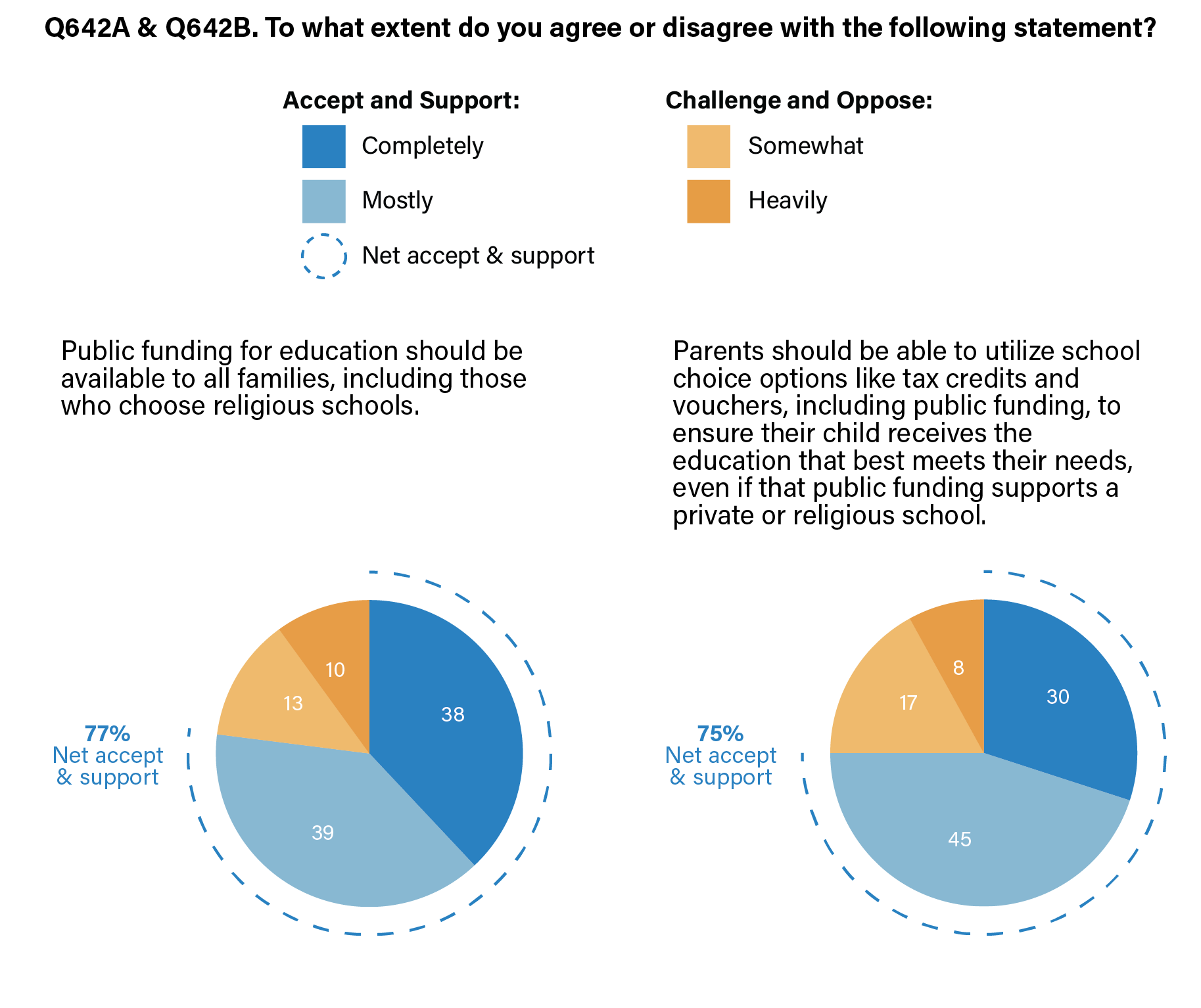
As discussed more in the key takeaway on parental rights, this year’s Index asked several questions concerning specific organizations that provide services to the community: schools. School choice and state funding for religious schools is a burgeoning political issue. In Oklahoma Statewide Charter School Board v. Drummond, the Supreme Court declined to settle the question of whether or not religious schools became “state actors” simply because they received state funds, leaving in place a decision by the Oklahoma Supreme Court that blocked several religious schools from participating in Oklahoma’s charter school program because of their religious nature. Americans were split on the Supreme Court’s decision (or lack of one), with 51% registering opposition, despite only 20% registering familiarity. About three-quarters of Americans supported allowing public funding for education to flow to all families, including those who choose religious schools.
In the aftermath of the coronavirus pandemic, where even public school went remote, it is hardly surprising that Americans are open to new options for schooling. What is more surprising – but perhaps also more important – is the openness to allowing public funds to flow toward the entire public’s education, even if those funds permit students to attend religious schools. These sorts of school choice options are especially beneficial to minority groups, who may have difficultly observing their faith in traditional schooling contexts. With such high levels of support for allowing government funding to flow to charities, schools, and other religious organizations that provide services to their communities, it will not be surprising if support for school choice continues to grow.
This year’s findings show that Americans support ensuring that religious individuals and organizations can freely serve their community. It is little surprise that most Americans want the government out of the way of those who are inspired by their faith to do good, and it is possible this commonsense belief will push the score of the Church and State dimension even higher in future years.
Religion in Action
The Religion in Action dimension reveals opinions about public acceptance of religious expression – especially from minority traditions – in the public square. It asks about religious practice across a variety of contexts and situations.
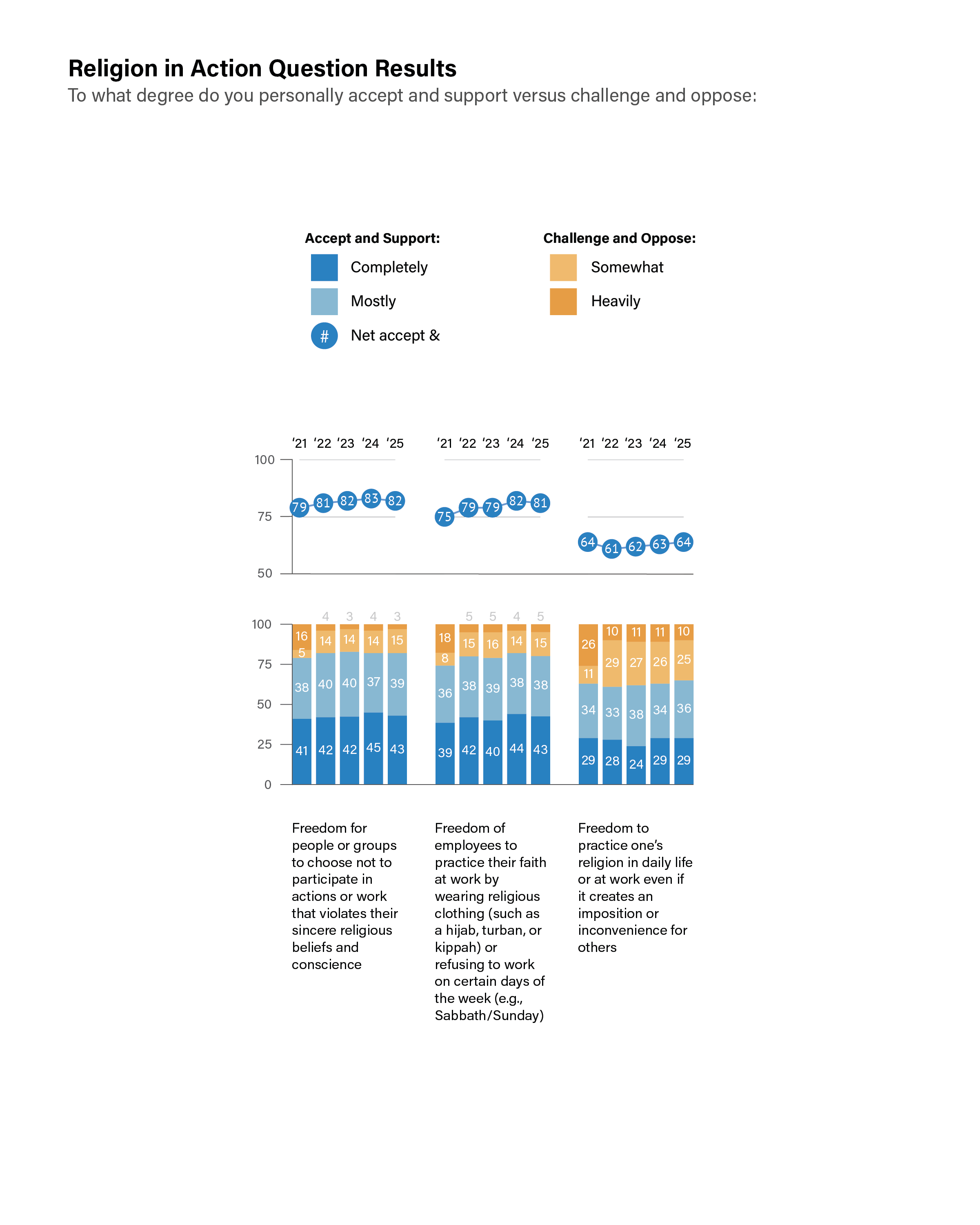
The Religion in Action dimension tests Americans’ acceptance of religion beyond the four walls of a home or place of worship. Whether or not Americans can bring their beliefs into the workplace is a major test of America’s commitment to religious freedom – after all, Americans spend much of their life in the workplace, and religious freedom means little if it means nothing most waking hours.
This year saw a slight decline in this dimension score, from 70 to 69. The primary reason for the decline was small drops in total support for the freedom for employees to wear religious apparel or take off certain days of the week in accordance with their faith tradition and the freedom for people to choose not to participate in actions or work that violates their sincere religious beliefs.
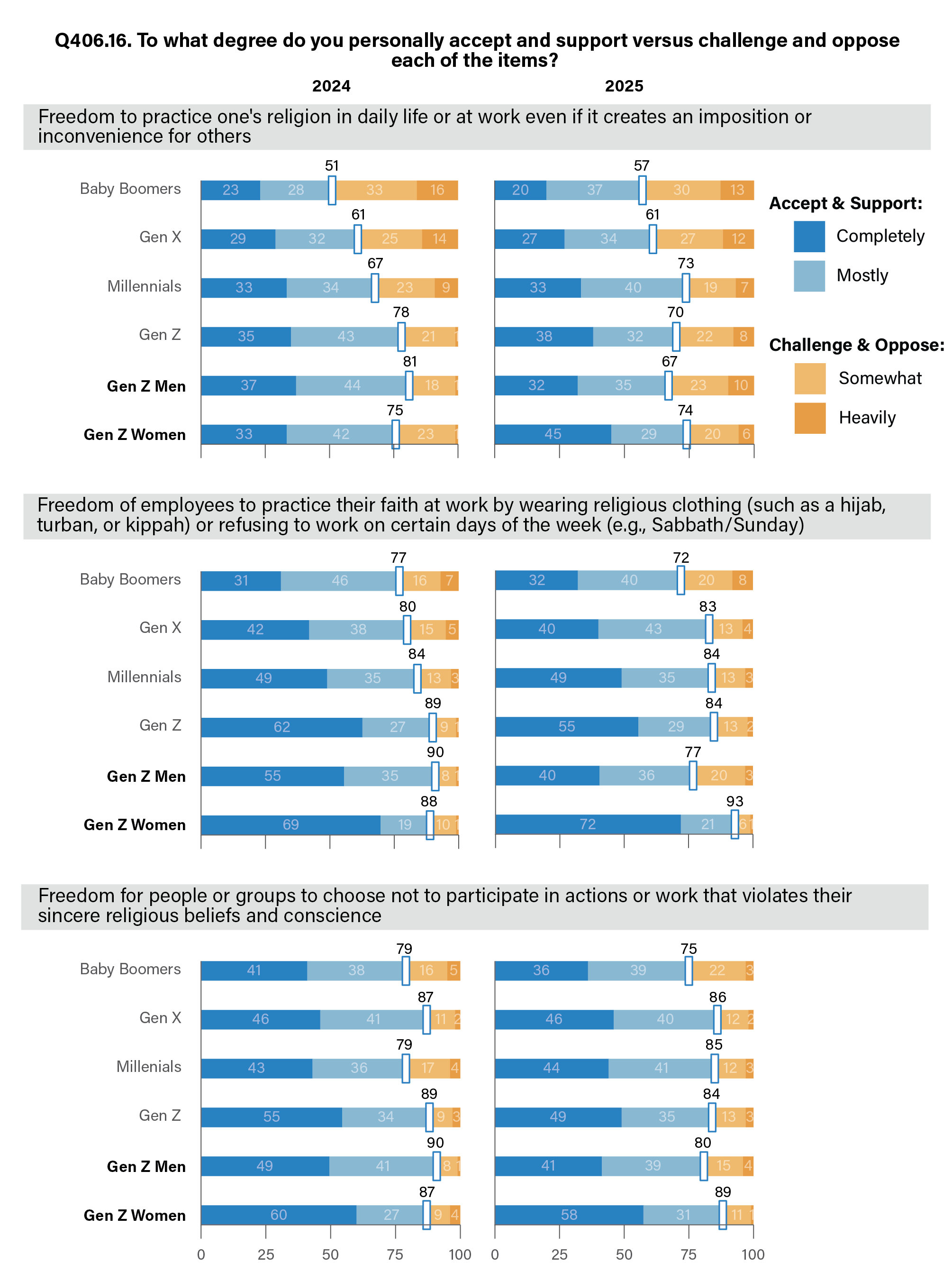
Although these minor dips are small and year-to-year fluctuations are to be expected, we saw much larger movement at the generational level. Gen Z is the generation most supportive of Religion in Action, but while this year the Index tracked a small rise in their complete support for the freedom to practice religion in daily life, even if it creates an inconvenience for others, we saw larger drops in complete support for the two other core questions. This could be (at least in part) due to skepticism of pluralism leading to a decline in support for the freedom to wear religious clothes such as a turban or hijab. If this is true, it appears to be disproportionately affecting Gen Z men – only 77% of whom accept and support this freedom, compared to 93% of Gen Z women. This is a shift from 2024, when 90% of Gen Z men supported this freedom, compared to 88% of Gen Z women, although this drop is not statistically significant. Whatever the cause, it is surprising – Gen Z’s support for these freedoms had, as a whole, been trending upwards since 2020.
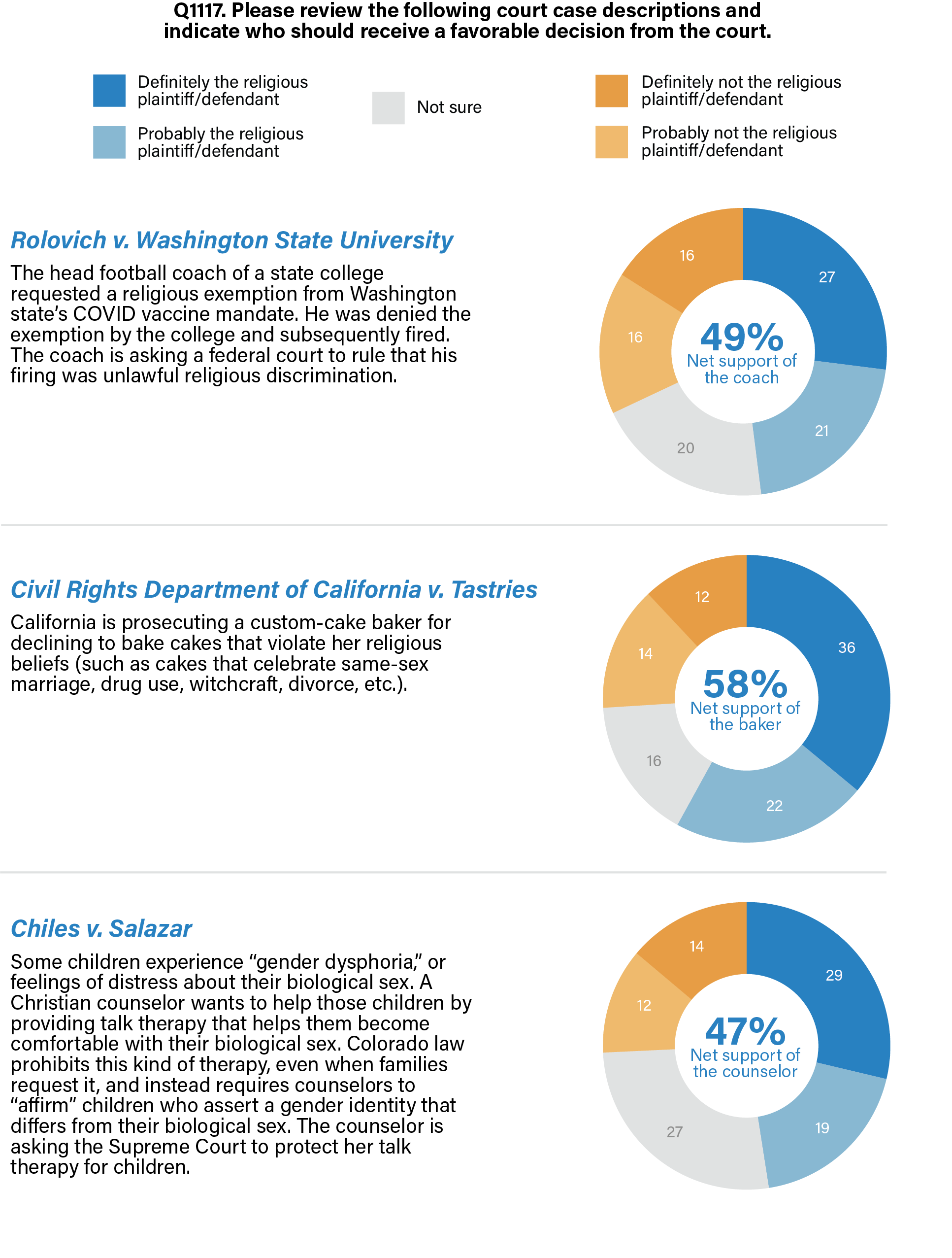
This year – as discussed more fully in our key takeaways – the Index asked several questions that touched on matters of the workplace. Our results found at least a plurality of support for a coach who filed a lawsuit after being fired instead of receiving a requested religious accommodation for a COVID vaccine (49%), a cake artist whose livelihood was threatened by the state of California because of her refusal to make cakes that violate her religious views (58%), and a Christian counselor who wishes to provide talk therapy to children to help them overcome their gender dysphoria but is forbidden from doing so by Colorado law (47%). In all of these cases, less than a third of Americans opposed the individuals exercising their religious beliefs in the workplace. This is very heartening news, and helps contextualize the slight declines this dimension saw this year: when the rubber meets the road, Americans still throw their vote in with the individual trying to live out their faith.
2025 Key Findings
Faith in the public square is on the rise
In this year’s Index, findings across the board point toward a notable trend: Americans increasingly recognize and welcome the role of faith in the public square, even where political opinions and preferences differ. 2025’s polling saw measurable upticks in the public estimation of religion, in support for religious expression, and, to varying degrees, in the intensity of faith among religious Americans. On a foundational level, these rises across the Index suggest more Americans are viewing religion as a central and influential tenet of national life.
This year’s Index saw a broad upward shift in the degree to which Americans value religion in their personal lives. The importance of religion to Americans remained high, with seven-in-ten (70%) respondents saying religion is at least somewhat important in their lives – 8 points higher than 2020’s low. While Americans’ overall religiosity appears to have remained stable from last year, this year’s Index found that the intensity of religion’s importance has risen: the share of respondents who regard religion to be very or extremely important has risen by 4 points last year to 45%, a 7 point increase from 2022. And among respondents who reported having a religious affiliation, the share who also ranked religion as very or extremely important rose by 5 points, to 55%. One plausible analysis of these findings is that overall religiosity is holding steady, but the intensity and importance of religious belief among the faithful is increasing. However, it is important to contextualize this intensity by noting that it may not directly translate to action: weekly and near-weekly attendance to religious institutions has remained steady.
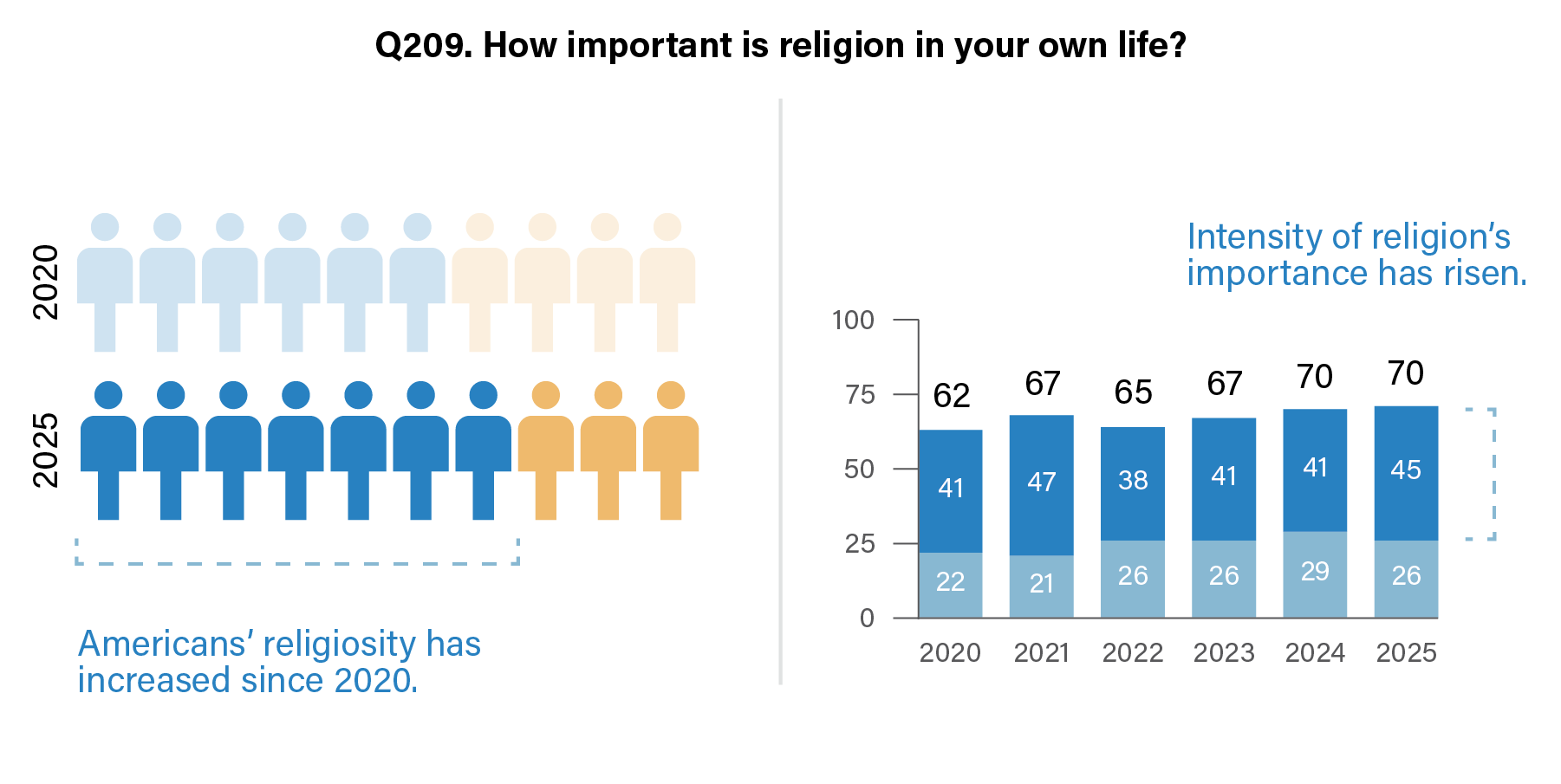
What appears more consistently is that the rising importance of faith on a personal level is correlated with increased support for religion and religious activity in the public square. This year’s findings show that Americans are increasingly welcoming toward religion being a more visible and active component of shared, public life: a majority of Americans (57%) said that the freedom of religion is inherently public, meaning that people of faith should be free to exercise and share their religious beliefs in school, at work, on social media, and in other public spaces. This figure has risen by 5 points since 2020, and includes nearly 2 in 5 who themselves are not people of faith (38%) and 49% of those who are not members of a religious institution. Gen Z, a key factor in multiple gains captured across this year’s Index, has the highest generational support for religious freedom being inherently public at 64% (7 points above the average and 15 points above Boomers), marking another possible litmus test for the future of American society under this expressive cohort.
Relatedly, a rising number of Americans view our society as being accepting of people of faith in their ability to live according to their beliefs. This year, 38% of Americans said they consider society to be completely or a good amount accepting, but when asked about their personal views, 73% said they consider themselves to be completely or a good amount accepting toward people of faith and their ability to live out their beliefs. This latter score of 73% personal acceptance of people of faith, representing more than seven in ten Americans, maintained last year’s score and a has increased by 15 points since 2020. And while a sizable gap remains between Americans’ perceptions of society’s acceptance of people of faith and personal acceptance, the share of respondents who consider society to be at least a moderate amount accepting increased by 4 points to a new high of 78%.
Younger Americans also played a major role in the rapidly rising support for religious sharing seen in this Index. The Religious Sharing dimension, a cumulative score reflecting support for the freedom to share one’s religious beliefs and to preach to others, jumped by three points this year to a new high score of 75. Nearly nine in ten Americans (87%) support the freedom to express or share one’s religious beliefs with others, marking another new high score. Gen Z’s above-average support for Religious Sharing has seen a dramatic upswing in the last several years (up 12 points since 2020, including a large 25 point increase in support for the freedom to express or share religious beliefs with others), making them the most supportive generation of this dimension. While Gen Z is especially enthusiastic, rising year-by-year support for these freedoms is distributed across American society and suggests the presence of a real cultural shift in favor of free religious expression. This shift appears to be a “rising tide” even for the expression of unpopular or controversial beliefs – for example, a new high of 80% of respondents completely or mostly accept that an individual or group should be free to believe in traditional marriage without facing discrimination or government penalties.
Alongside rising support for religious expression, this year’s Index reflected an American society in which religion is an increasingly visible and valued aspect of public life. For example, 71% of Americans support public school students leading prayers on field before a football game, 64% support city council meetings being opened with a prayer led by a local religious leader, and 74% of Americans support city governments allowing a nativity scene on city property. Similarly, 79% of Americans – nearly eight in ten – support the US government partnering with religious charities to help those in need. These findings suggest that Americans support an active role for religion in society, and that a significant majority recognize and value the charitable and social contributions of faith in the public square.
America’s youngest voters, Gen Z, stand above every older generation in their support for Religious Sharing and for Religion in Action, and in many ways are the generation driving the national trend in support of practicing and expressing faith in the public square. As discussed in prior Indexes, Gen Z leads older generations in complete support for the freedoms of employees to express their faith in daily life or the workplace. This includes the freedom to wear religious clothing (such as a hijab, turban, or kippah), and even practices that might create an imposition for others like the freedom not to work on certain days of the week if required by one’s faith. However, these gains are increasingly due to Gen Z women’s above-average support for such accommodations, especially for minority faith practices, while Gen Z men lag in support for the same metrics. For example, while 72% of Gen Z women completely accept and support the freedom of employees to wear religious clothing such as a hijab, turban, or kippah, only 40% of Gen Z men share the same level of support, a 32 point difference (77% of Gen Z men at least mostly support this freedom).
A similar gap persists for the freedom to practice one’s religious beliefs even if they are contrary to accepted majority practices (such as not drinking alcohol, not saluting the flag, not eating pork/beef, or for wearing a turban, burka, or hijab, etc.), which 67% of Gen Z women completely support compared to 51% of Gen Z men. Gen Z men were also less convinced that “tolerance and respect of a broad array of ideas and beliefs about God” are absolutely essential to religious freedom, with only 44% agreeing compared to 60% of Gen Z women. Additionally, Gen Z women were more completely supportive of the freedom for individuals or groups to choose not to participate in actions that violate their sincere religious beliefs and conscience (58%) than their male counterparts (41%) by 17 points. It is important to note that these wide gender gaps in support are not reflected in all American men and women, but are unique to Gen Z.
However, Gen Z men outscored their female counterparts in several other areas. For instance, male Gen Z voters were significantly more supportive of the freedom for people to rely on their religious beliefs to guide their voting decisions (84%) than female Gen Z voters (65%), a 19 point gap. Gen Z men as a whole were more likely to say that the freedom for individuals or groups to believe that marriage is the union of a man and a woman without being penalized by the government was an essential or important part of religious freedom than Gen Z women (84% versus 68%). Similarly, a majority of Gen Z men (57%) supported government use of religious symbolism in public displays, while only a minority (42%) of Gen Z women agreed.
These results paint a complicated picture of Gen Z. While Gen Z men are intensifying in religiosity and emphatically signaling their support for the ability to express one’s own attitudes and beliefs without restriction or punishment, they may be moving away from more pluralistic, inclusive expressions of religious freedom. Gen Z men may increasingly hold a more narrow view of religious freedom, in which someone is entitled to have and express their own beliefs, “as long as those beliefs don’t burden me.” Many of these findings track with the findings by other national polls that young men are increasingly leaning to the right and less concerned with the risk of offending others with their beliefs – although, as this Index finds, Gen Z men’s positions are in some cases less supportive of religion than the average conservative respondent, and represent a distinctive deviation from the norms of older generations. Gen Z women, on the other hand, maintain strong support for minority faith accommodations and above-average approval of religion’s charitable contributions to society, but appear less positive about the current direction of religion in the political sphere. This widening divergence in Gen Z’s interpretation of religious freedom may also be reflected in their view of the Supreme Court. Whereas 64% of Gen Z men trust the Supreme Court to make the right decisions in religious freedom cases, only 31% of Gen Z women say the same – a significant 33-point gap between peers of the same age.
It remains to be seen whether Gen Z’s differences on religious freedom will narrow or widen in coming years, but regardless, both Gen Z men and women continue to play a major role in driving the rise of religious expression across American society. Gen Z’s young men and women alike view themselves as friendly toward people of faith, with 93% of Gen Z saying they are at least moderately accepting in supporting the ability of people of faith to believe and live according to their beliefs (although even here, there is a gap in intensity, with 42% of Gen Z women saying they are completely accepting of this freedom, while only 24% of Gen Z men say the same). Despite these differences, America’s youngest voters appear poised to continue ushering faith and religion to a more prominent place in the public square. Religious freedom unifies Americans
Religious Freedom Unifies Americans
The legal protection of religious freedom for all faiths, enshrined in the First Amendment of the Constitution, is a bedrock foundation to the civil and human rights enjoyed by Americans, and an essential component to living in a pluralistic society. Americans’ shared awareness of this right, and of the essential value of protecting religious freedom, is a uniquely unifying force amid a polarized time in American society. This year, the role of religious liberty as a place of agreement among Americans was remarkably evident in a number of high-profile court cases which garnered strong support from the public. From precedent-setting Supreme Court rulings to lower court decisions, Americans affirmed their appreciation for robust legal defenses of religious liberty and emphasized their approval for a system of justice that ensures Americans of all beliefs can have their day in court.
This year’s Index found that even in areas that typically draw partisan division, the legal protection of religious freedom is notably unifying to public opinion. Following a year in which the high court ruled in two important cases to uphold the rights of religious plaintiffs, a majority of Americans trusted the Supreme Court to make the right decision, especially in cases having to do with religious freedom. Religious Americans were more likely to trust the Supreme Court in religious liberty decisions, with 64% expressing confidence in religious liberty decisions versus 57% generally.
In 2025, the Supreme Court decided two major religious liberty cases, Mahmoud v. Taylor and Catholic Charities Bureau v. Wisconsin Labor and Industry Review Commission. (Becket represented the religious plaintiffs in both cases.) Mahmoud v. Taylor was a case brought by a group of concerned parents, asking the school board in Montgomery County, Maryland, to allow them to opt their children out of reading new “inclusivity” books with LGBT+ themes that the Board had introduced into its pre-K to eighth grade curriculum. The parents – a diverse group including Muslims, Christians, and Jews – all agreed that these books interfered with their attempts to raise their children in their faith traditions. The Supreme Court ruled in favor of the parents, holding that parents have the right to guide their children’s religious upbringing, even in the public classroom.
Sixty-two percent of Americans said they support Mahmoud’s outcome, proving the Supreme Court’s ruling in this case – which vindicated the right of parents to raise their children in accord with their beliefs – popular by solid majority. Nearly half of Democrats agreed (47%), with above average support shown by Independents (66%) about on par with Americans as a whole and Republicans (75%) above average. Given Mahmoud’s subject matter, it is unsurprising that respondents with children in their household were more likely to approve the Court’s ruling at 71% support. This year’s data shows that more Americans agreed on supporting the outcome in this case than reported trusting in the Supreme Court overall, and the support surpassed even trust in the Supreme Court in religious liberty cases (55%), showing that Americans are unified when it comes to protections of religious freedom, even when those same Americans are divided on their view of the Court. Even among those respondents who said they distrust the Supreme Court to make the right decision, more than half (53%) supported the same Court’s decision in Mahmoud v. Taylor – suggesting that these religious liberty protections enjoy more support than the Supreme Court generally. These findings are encouraging, showing that even those inclined to distrust the Court rallied around its decisions when they upheld religious freedom.
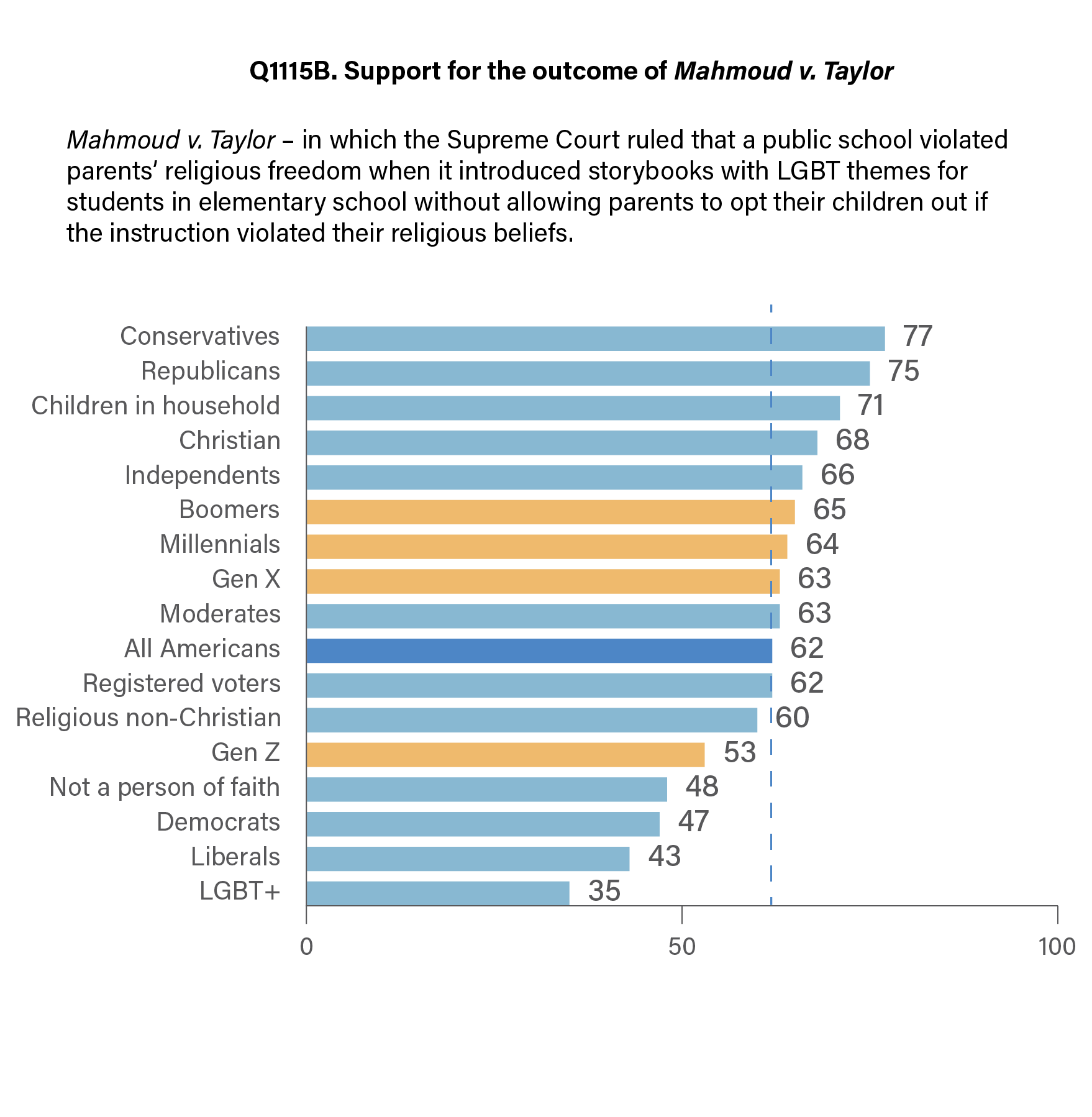
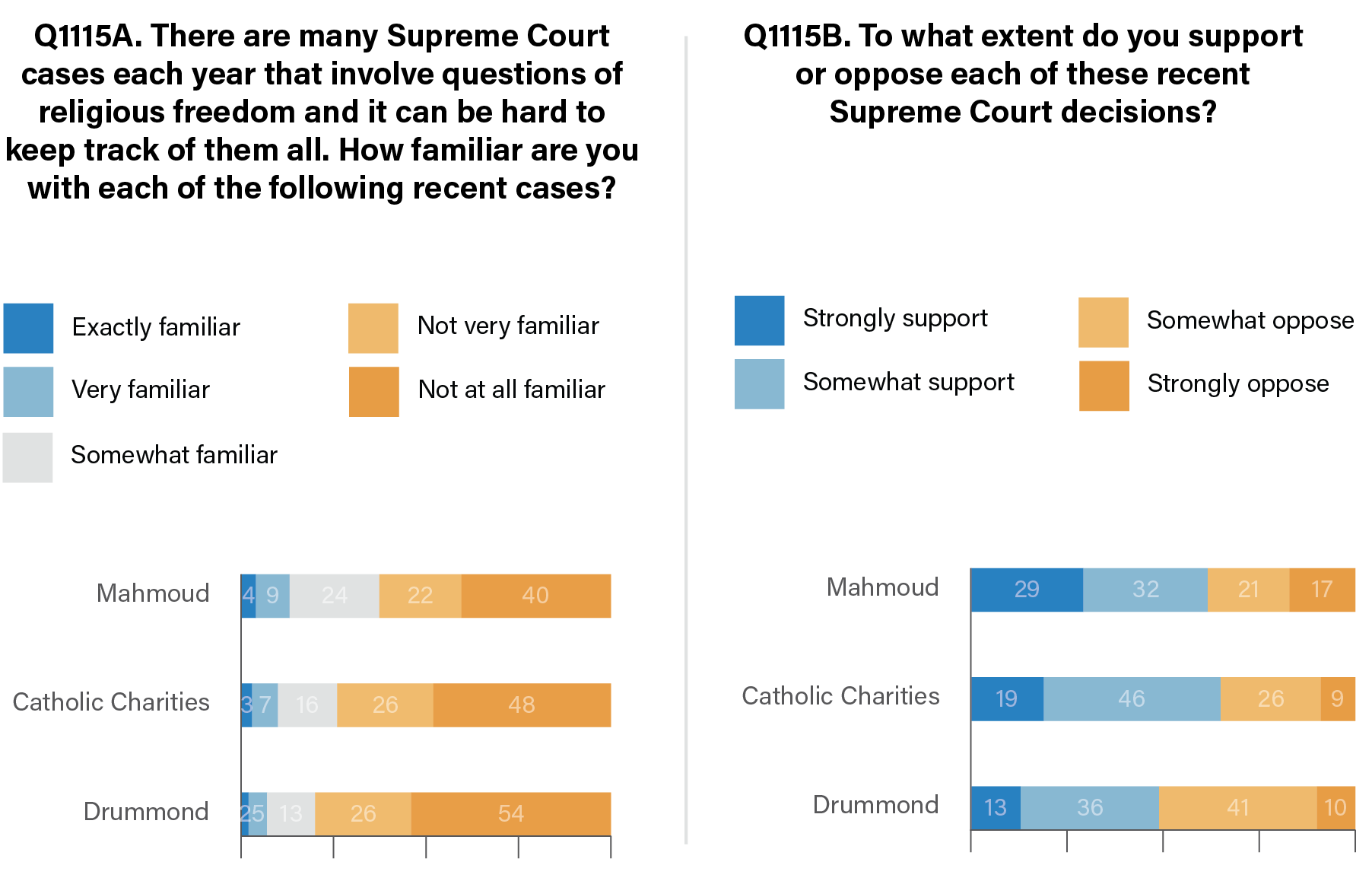
Support for Mahmoud v. Taylor also outpaced Americans’ familiarity with the case: only 38% of respondents said they were at least somewhat familiar with Mahmoud. Among those already familiar with the case, support for the outcome rose slightly to 65%. Religious non-Christian respondents were more likely to be familiar with Mahmoud (47%) than Christian respondents, which may stem from the fact that the case included several plaintiffs from minority non- Christian faiths. Sixty percent of religious non-Christian respondents supported the case’s outcome.
In Catholic Charities Bureau v. Wisconsin, the Wisconsin State Supreme Court ruled that the Catholics Charities Bureau’s work serving the poor and needy (in accordance with church teaching) did not qualify as religious activity for purposes of state unemployment law. Catholic Charities appealed this decision to the Supreme Court.
The Supreme Court unanimously ruled in favor of the Catholic Charities Bureau, deciding that that Wisconsin was discriminating against the Bureau by saying that its charitable works did not qualify as religious activity, while the charitable works of other religious organizations did qualify. As was the case in Mahmoud, Americans strongly approved of this decision, with 65% supporting the case’s outcome. In fact, support for Catholic Charities was even stronger than support for Mahmoud despite fewer Americans being familiar with the case, with only 26% of respondents saying they were at least somewhat familiar but 65% expressing support. Also like Mahmoud, those already at least somewhat familiar with the case were more supportive of Catholic Charities’ outcome (69%), and people of faith who were also familiar were even more supportive (73%). Once again, even those who said they distrust the Supreme Court supported Catholic Charities by a solid majority of 61%. Reactions to the case’s outcome were notably shared across demographic lines, again displaying more unity than disagreement around religious freedom: 60% of Democrats supported the case, alongside 64% of Independents and 69% of Republicans. And despite the case clearly involving a Catholic plaintiff, people of faith did not diverge greatly in their support, with 61% of religious non-Christians and 64% of non-Catholic Christians complementing the highest support by Catholics (69%). A majority of non-religious respondents also supported the outcome of the case (61%).
A third Supreme Court case, Oklahoma Statewide Charter School Board v. Drummond, generated more mixed responses from respondents. Drummond concerned whether an online Catholic school could become a publicly funded charter school in the state of Oklahoma. (Becket wrote an amicus brief in support of St. Isidore of Seville Catholic Virtual School, a separate Oklahoma school that was prevented from becoming a charter school because of its religion, in another case that was heard by the Supreme Court together with Drummond.)
The Supreme Court split 4 – 4 on the case (with Justice Barrett recusing herself from the case), leaving in place a state court ruling barring the school from the state charter school program, and leaving the question of whether or not a religious school can be excluded to be decided at a later date. Much like the Supreme Court, respondents split evenly on the question, with a bare 51% of respondents opposing the Court’s decision to allow the Oklahoma charter program to continue to exclude the Catholic school, and 49% of respondents agreeing with the Court. Most Americans (80%) were unfamiliar with Drummond, but familiarity with the case was associated with a large movement in favor of the Supreme Court’s decision (13 percentage points). More women were opposed to this decision (57%) than men (45%), an interesting divergence from the trend seen in both Mahmoud and Catholic Charities where men were more supportive of rulings that favored the religious party than women (by 8 and 9 points respectively). Interestingly, Americans were evenly split on the Drummond decision whether they were a member of a religious institution (51% opposed) or not (52% opposed). Those who said they trust the Supreme Court to make the right decision in religious liberty cases were less supportive of the Court’s decision in Drummond, with only 45% of this group supporting the decision to exclude the Catholic school from the charter program.
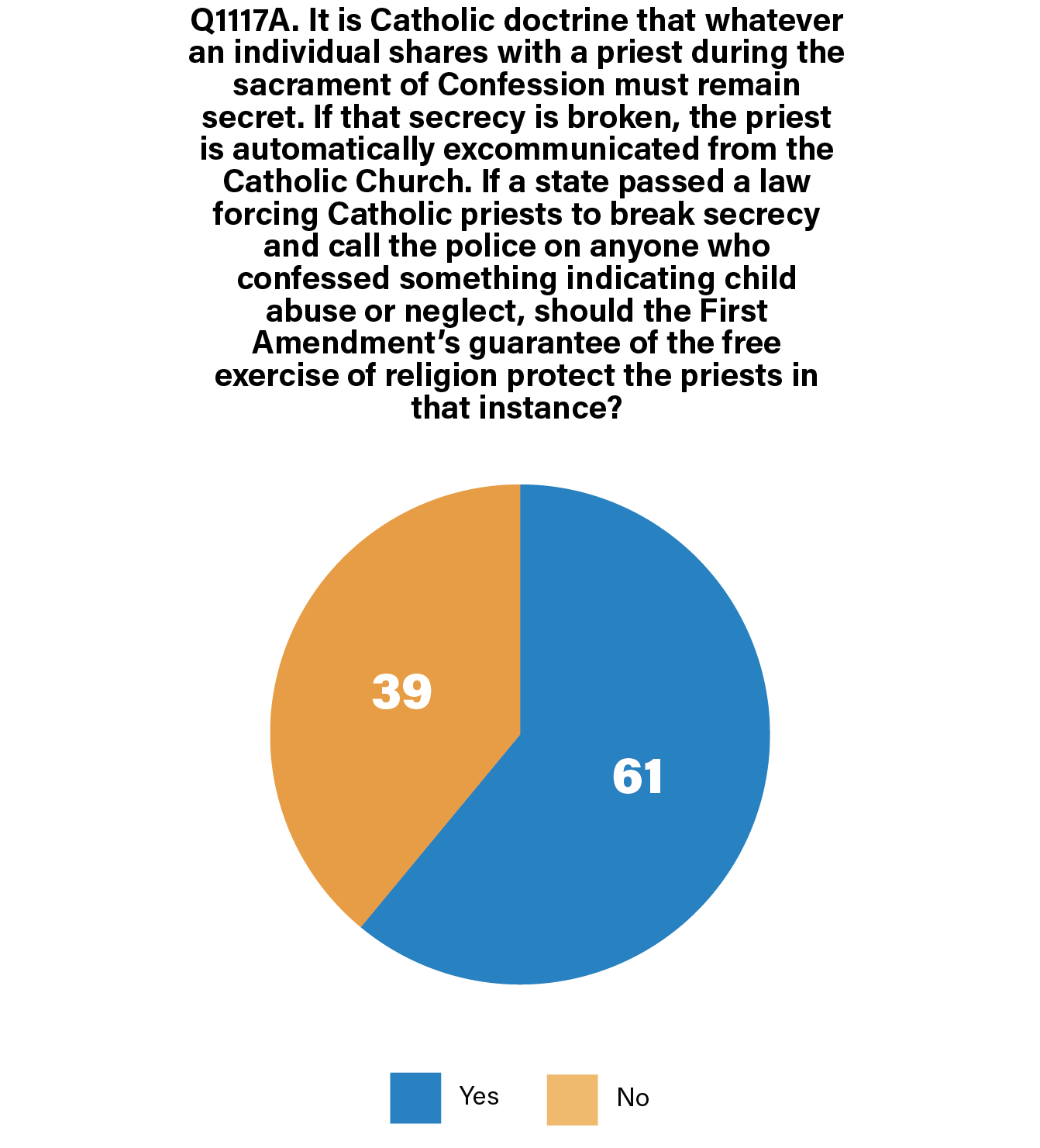
This year’s Index also asked a number of questions about other cases dealing with religious freedom that might find themselves before the Supreme Court. In all of these cases, Americans tended to side with religious organizations or individuals and against the government, reinforcing the importance of religious protections to Americans. This was perhaps most striking in a question the Index asked about whether the First Amendment should protect priests from a law forcing them to break the seal of confession in order to report child abuse or neglect. Confession, a core sacrament of the Catholic faith, is kept absolutely secret, and Americans overwhelmingly (61%) agreed that the First Amendment should protect the priest in such a scenario. In a related Becket case (Etienne v. Ferguson) the state of Washington ultimately agreed, pledging in the fall of 2025 not to attempt to force priests to violate the confessional seal after a federal court blocked the law in question.
In another ongoing Becket case, Rolovich v. Washington State University, the head football coach of Washington State University, Coach Nick Rolovich, requested a religious vaccine exemption. Instead of receiving an exemption, he was fired, and subsequently sued the school, asking the courts to rule that he was unlawfully discriminated against on the basis of his religion. Only 32% of respondents sided with the school, with nearly half (49%) saying that Coach Rolovich should definitely or probably win his case.
The Index also asked about the case of a Christian counselor who wants to provide talk therapy to minors with gender dysphoria that helps them become comfortable with their biological sex, but is forbidden from doing so by state law. In October 2025, the Supreme Court heard a challenge to a Colorado law like this in Chiles v. Salazar, and nearly half of Index respondents (47%) sided with the counselor, while only 26% indicated they thought the state should prevail.
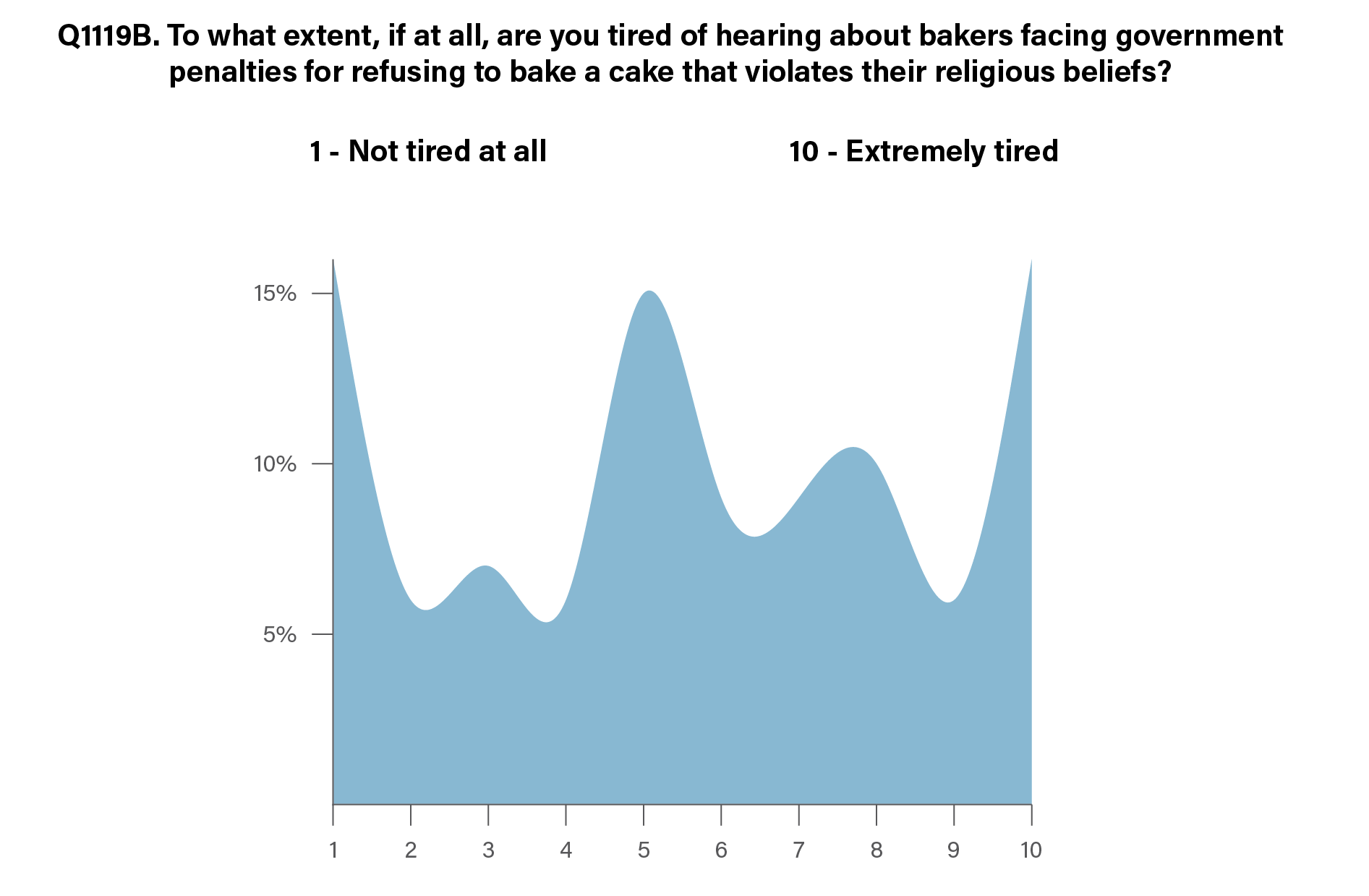
Finally, this year’s Index asked several questions about the rights of custom cake-bakers to decline to bake cakes that conflict with their religious views. In 2017, California filed a lawsuit against Cathy Miller, the owner of Tastries Bakery, because Miller refused to design wedding cakes that go against her Christian views, including cakes with gory or pornographic content, or cakes celebrating divorce or same-sex marriage, which are contrary to her beliefs about the Christian sacrament of marriage. Miller referred a same-sex couple who asked her for a custom wedding cake to another baker, but California sued against her, and has continued to pursue her in court despite multiple Supreme Court decisions protecting the right of wedding vendors to follow their faith and decline to express messages they disagree with. The Supreme Court declined to hear her case in December of 2025.
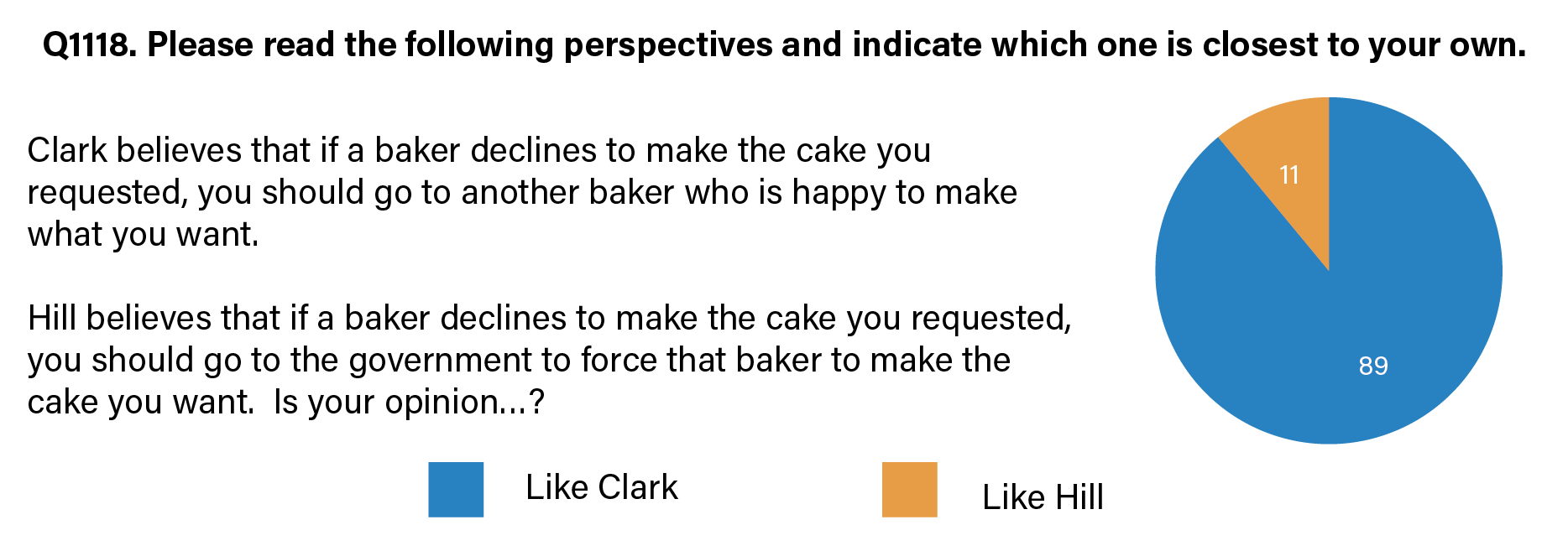
However, 58% of Americans sided with Cathy, with only 26% believing that California should prevail in court. While people of faith were more likely to support Cathy (63%), nearly half of people for whom faith is not important sided with her as well (47%). Furthermore, 89% of Americans – nearly 9 in 10 – agreed that if a baker declines to make a cake you want, you should go to another baker – not drag the government into the question.
This year, Americans continued to show strong support for the rights of Native Americans to utilize sacred sites central to their religious practices. In the case Apache Stronghold v. United States, Becket represents members of the Western Apache tribe and allies seeking to fight the federal government’s proposal to transfer ownership of their most sacred site, known as Oak Flat, to a foreignowned mining corporation to turn the site into a copper mine, which would destroy the ancient site and end the Western Apache’s religious practices. An overwhelming majority of Americans – 71% – support protecting Native American’s sacred sites on federal land against such transfers. There was virtually no difference in support from respondents who say faith is important and those for whom it is not important (71% and 73% respectively), emphasizing that Americans of all stripes deeply value religious protections such as these. Majorities of each political party also supported the tribe, with 66% of Republicans, 73% of Independents, and 80% of Democrats in favor of protecting the sacred site. In May of 2025, the Supreme Court declined to hear Apache Stronghold’s case – to which Justice Gorsuch wrote a dissent joined by Justice Thomas, calling the rejection of the case “a grievous mistake.”
Even while Americans disagree on their confidence in the Supreme Court, a significant and diverse majority agree in supporting the religious freedoms at risk in Apache Stronghold and other religious freedom cases, once again underscoring that Americans are more unified when it comes to protecting religious liberty. This year’s Index findings attest that Americans not only value a judicial system that upholds religious liberty, but that the defense of religious liberty itself can be a uniquely unifying balm amid polarized times in American society.
Americans support religious parents’ right to faithfully educate their children
Past Indexes showed strong support for the rights of parents to guide the education of their children. This is an important cornerstone of religious freedom, and one that is vital to preserve the religious beliefs and traditions of minorities, whose needs may be overlooked or marginalized by majority-dominated public schools. This year’s results showed that support continues to rise, with strong majorities of Americans responding positively in favor of parental rights across a variety of questions.
Seventy-three percent of respondents agreed that parents are the primary educators of their children, should have the final say on what their children are taught in public schools, and should be able to opt their children out of objectionable and inappropriate content. This was a 4 point rise over last year, and a 10 point rise since 2021, when the question was first asked.
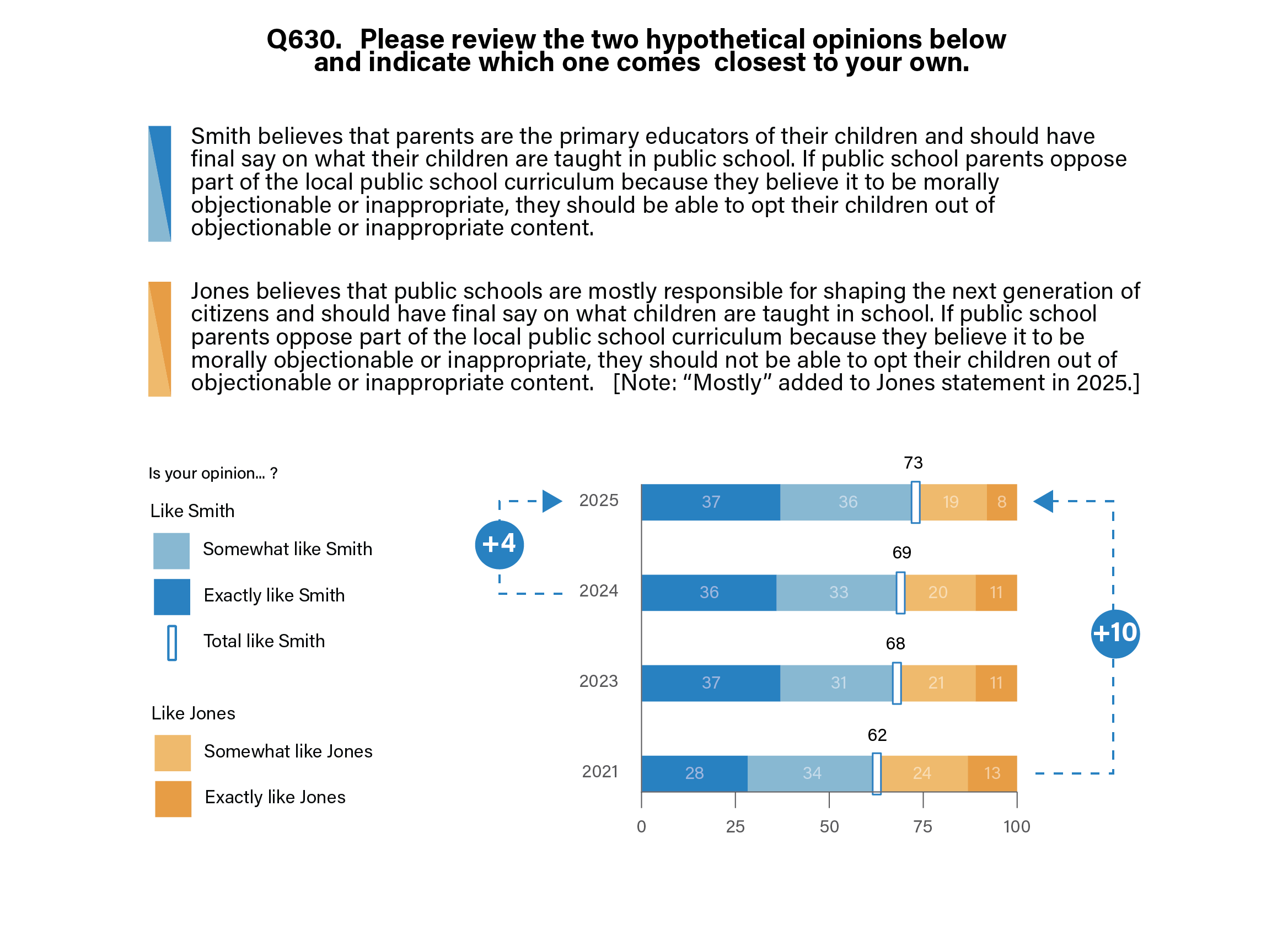
Perhaps unsurprisingly, respondents with children in their household were even more supportive (6 percentage points or 79%) of this position. However, respondents without children in their household were only slightly less likely than all Americans (71%) to support parental rights in this question.
This year, the Index also asks a new question on public funding for religious education. Half of respondents were asked whether public funding for education should be available to all families, including those choosing a religious education, while half of respondents were asked a similar question about whether publicly funded school choice options such as tax credits and vouchers should be available to parents, even if they choose to use those funds for private or religious schools. This question is particularly interesting in light of the Supreme Court’s 2022 decision in Carson v. Makin, where the Supreme Court held that Maine could not exclude private religious schools from public funding simply because they were religious. We registered similar levels of support for the ability of parents to use public funding to educate their children at religious schools among both groups, with 77% and 75% support respectively. As before, respondents with children in the household were much more likely (10 and 11 percentage points, respectively) to support expansive school choice options, as were people of faith.
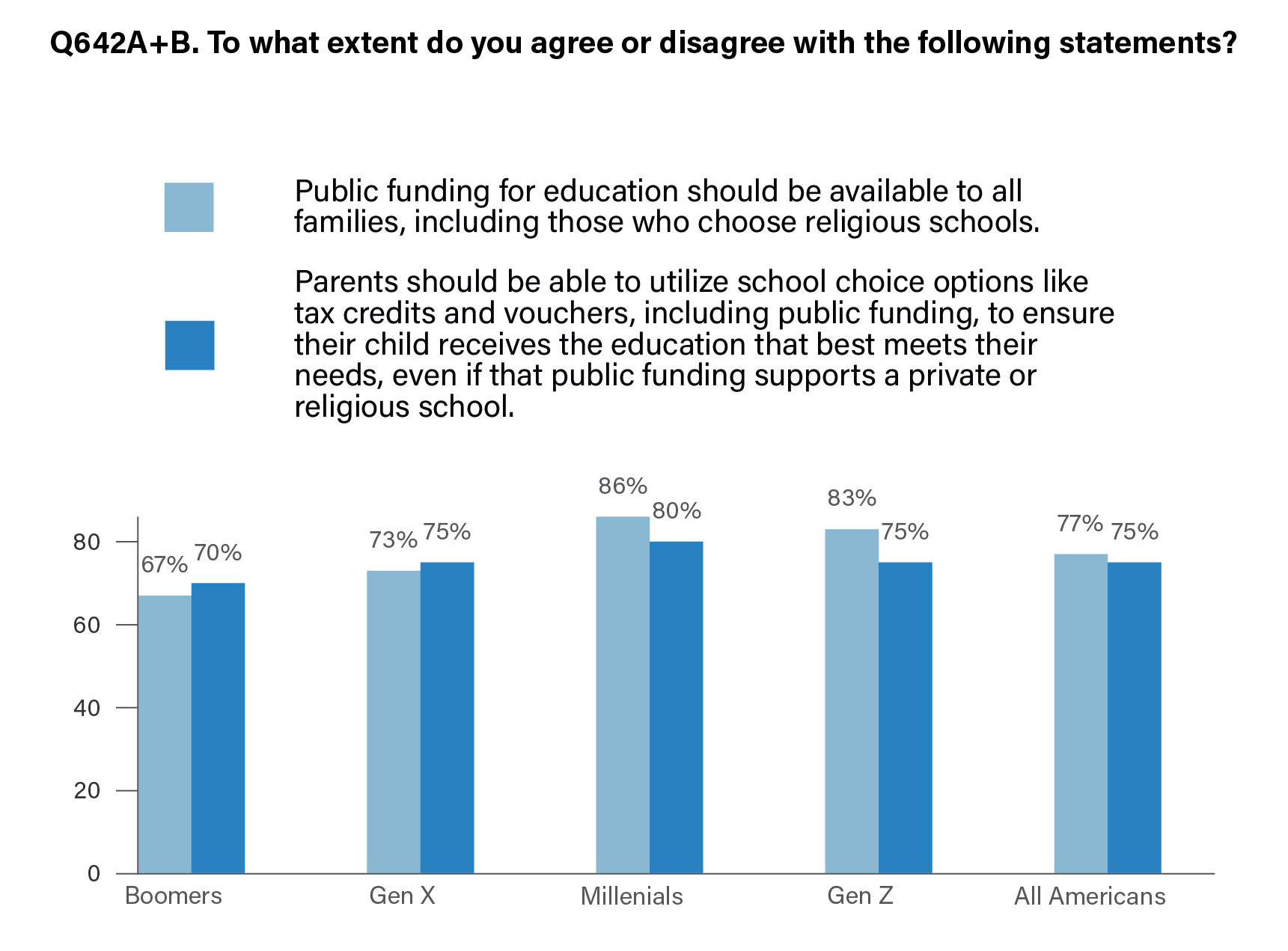
Interestingly, there were some signs that support for these questions was higher among younger Americans. When asked about making public funding available to families choosing a religious education, Millennials and Gen Z were both more likely than all respondents to express some level of support. This effect was cooler when vouchers and tax credits were specified (5 and 0 percentage points for Millennials and Gen Z, respectively). Contrast this with Baby Boomers, whose support was weaker, although a majority still supported school choice. This suggests that the popularity of school choice might rise even further in future years.
A similar question asked Americans to what degree they accepted and supported tax credits for parents that could be used to provide scholarships to any school, including private religious schools. Sixty-seven percent of Americans completely or somewhat accepted and supported this, and 60% thought it was either absolutely essential or at least an important part of religious freedom itself. Once again respondents with children in their household were more likely (10 percentage points) to support this, and support generally increased with younger generations, with 76% of Gen Z supporting these tax credits but support declining to 59% for Baby Boomers. Unlike some other questions, there is little division by gender among Gen Z respondents, with 77% of men and 75% of women Gen Z expressing support.
At 62%, total support for the Supreme Court’s recent decision in Mahmoud (discussed at greater length in our second key takeaway section) is somewhat softer than support for school choice and agreement that parents are the primary educators of their children. This is still a strong result in favor of the Supreme Court’s decision. As noted above, support for the court’s decision increased with familiarity, so a lack of familiarity with the specific case might be one reason why support for parental rights in the abstract was somewhat higher than support for Mahmoud.
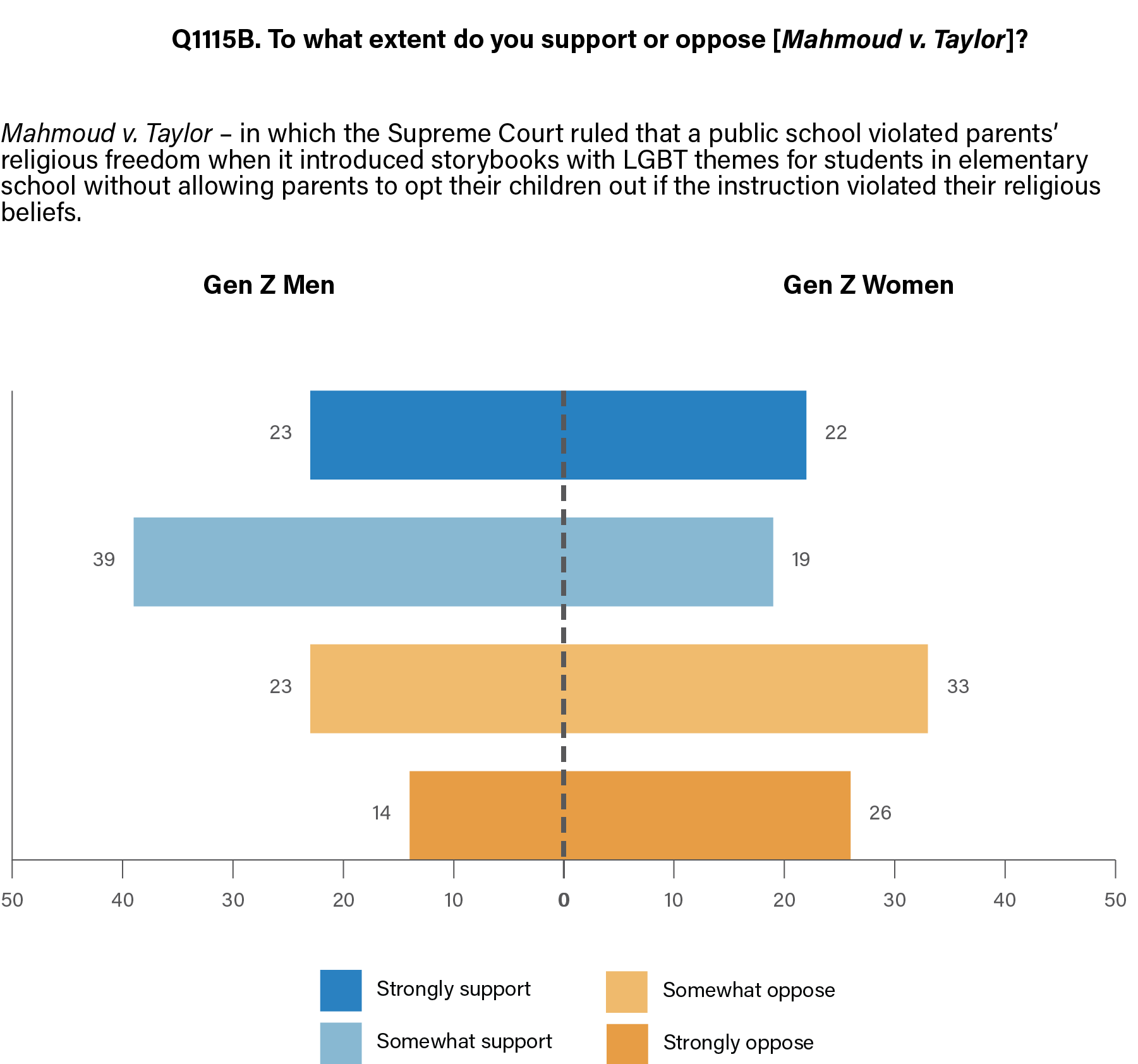
Another reason for the gap might be the specific issue in question: books with LGBT+ themes introduced to elementary-aged schoolchildren. As in other parental-rights questions, respondents with children in their household were much more likely (71%) to support the decision in Mahmoud, but while younger generations were warm toward parental choice, they had more mixed opinions of Mahmoud: 64% of Millennials supported the decision, but only a slight majority – 53% – of Gen Z. As in many other questions, there is a large gender gap here: 63% of Gen Z men supported the decision, but a minority of Gen Z women did (41%). This 22-point gap, however, is larger than the gap found in acceptance and support for the freedom to believe that certain behaviors (including gay marriage) were immoral, sinful, and should be avoided in our society – 71% of Gen Z men completely or mostly accept this freedom, but only 62% of Gen Z women say the same. When asked about trust in the Supreme Court to decide religious freedom cases, only 31% of Gen Z women indicated that they would trust the Supreme Court, compared to 64% of Gen Z men. Likely, then, Gen Z women’s lower trust in the Supreme Court was a contributing factor in their lower support for Supreme Court decisions like Mahmoud.
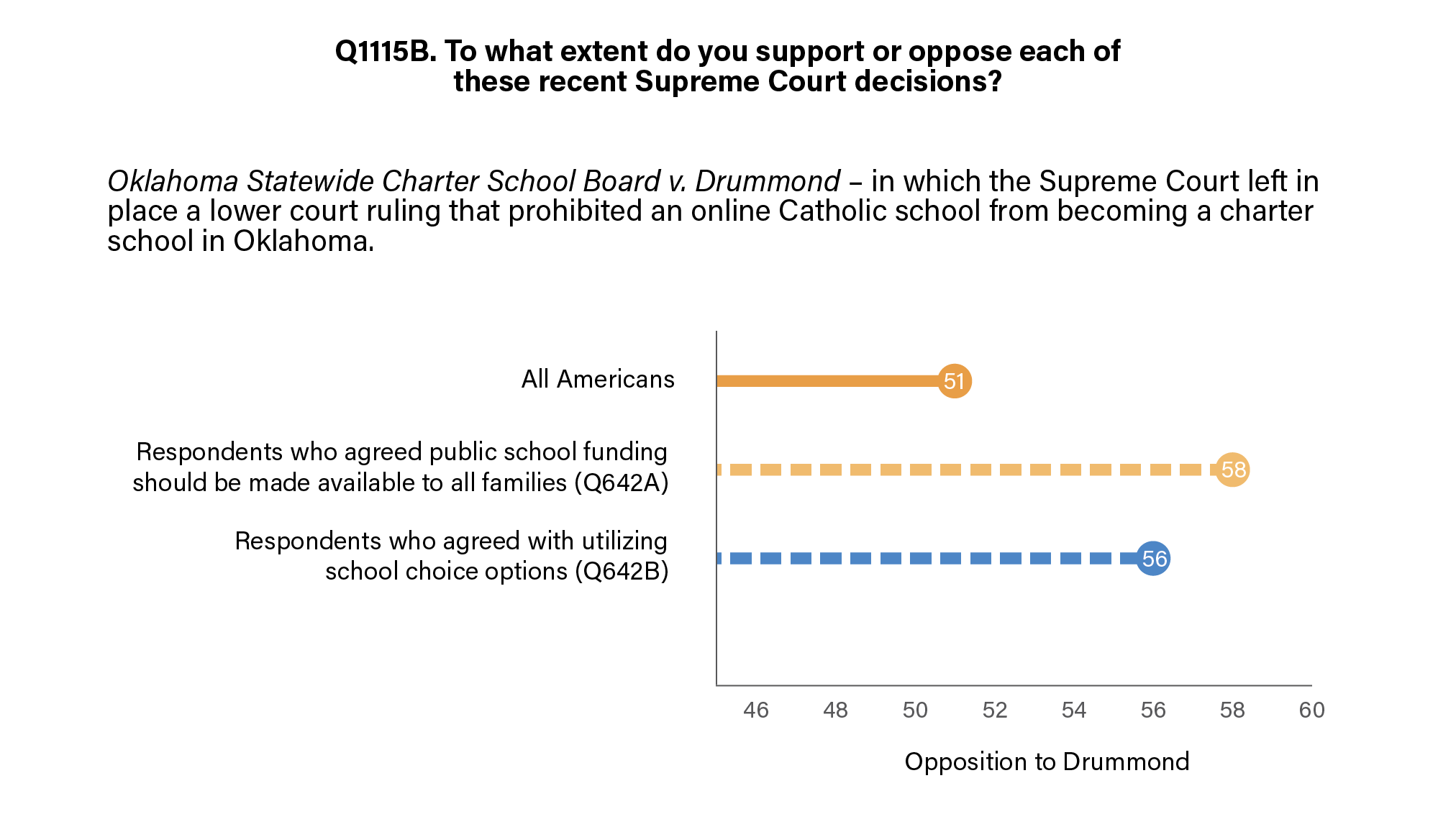
Although Mahmoud garnered broad majority support, respondents were more evenly divided on another case that went before the Supreme Court, Oklahoma Statewide Charter School Board v. Drummond (covered in more depth above in our second key takeaway). A thin majority – 51% percent of respondents – opposed the Supreme Court’s decision to leave in place a ruling that prohibited an online Catholic school from becoming a charter school in Oklahoma. Perhaps unsurprisingly, the Index found that support for school choice is correlated with greater opposition to the Drummondruling (which effectively limited school choice options): 58% of those who agreed public education funding should be available to all families, even for use at religious schools, opposed the ruling, compared to only 30% of those who disagreed on public funding. And those who agreed that families should be able to utilize all school choice options opposed the Drummond decision at 56%, compared to 36% of those who disagreed on school choice options. Although Americans may not yet have decided where they land on the exact boundaries of public support for private religious schools like charter school at issue in Drummond, they very clearly support the rights of parents to choose the best possible education for their children – even if that is a religious education, or an education at a religious school. And a clear majority agreed with the Supreme Court’s decision in Mahmoud, concretely confirming the longstanding abstract support this Index has reported for parental opt-outs from school curriculum that may be inappropriate or offensive. With increased options for school choice appearing even more popular among younger adults and clear Supreme Court precedent favoring parental rights being set, it will be unsurprising if public opinion continues to trend toward increased options and opportunities for families.
Conclusion
This year, the Index recorded its fourth year of growth, rising by a full five points from its all-time low score of 66 in 2020 to 71. Despite some questionable developments – including a gender divide between young men and young women that threatens to stifle their general trend of support for religious freedom and a concerning drop in belief that religion and people of faith are part of the solution to America’s problems – the overall picture is good. Church and State, traditionally the lowest-scoring Index dimension, reached a new high of 60, Religious Sharing surged from 72 to 75, and support for Religious Pluralism remained high and steady. Although this year’s Index found that Americans have cooled on the benefits of religion to society and are skeptical of institutions, they unify around the simple principles of religious freedom for all, even in difficult cases that invite scrutiny or controversy.
Last year’s Index noted that the culture war was still being fought over questions of religious freedom and parental rights, despite the overwhelming support for both among Index respondents. This year’s ruling in Mahmoud v. Taylor vindicated both, while another Supreme Court decision, Catholic Charities Bureau v. Wisconsin, protects the ability of religious nonprofits to serve in their community without government interference on the basis of their doctrine. These are positive developments that bring the law in the United States closer to what most Americans support.
We hope that this Index can help raise awareness of these developments, and continue to bring Americans – no matter their age, gender, political persuasion, religion, state, or creed – together in support of religious freedom for all.