City of Quincy, Massachusetts asks state’s high court to allow statues honoring firefighters and police Court will decide if Quincy can install statues that recognize the courage of its first responders
Media Contact
Ryan Colby 202-349-7219 [email protected]
Additional Information
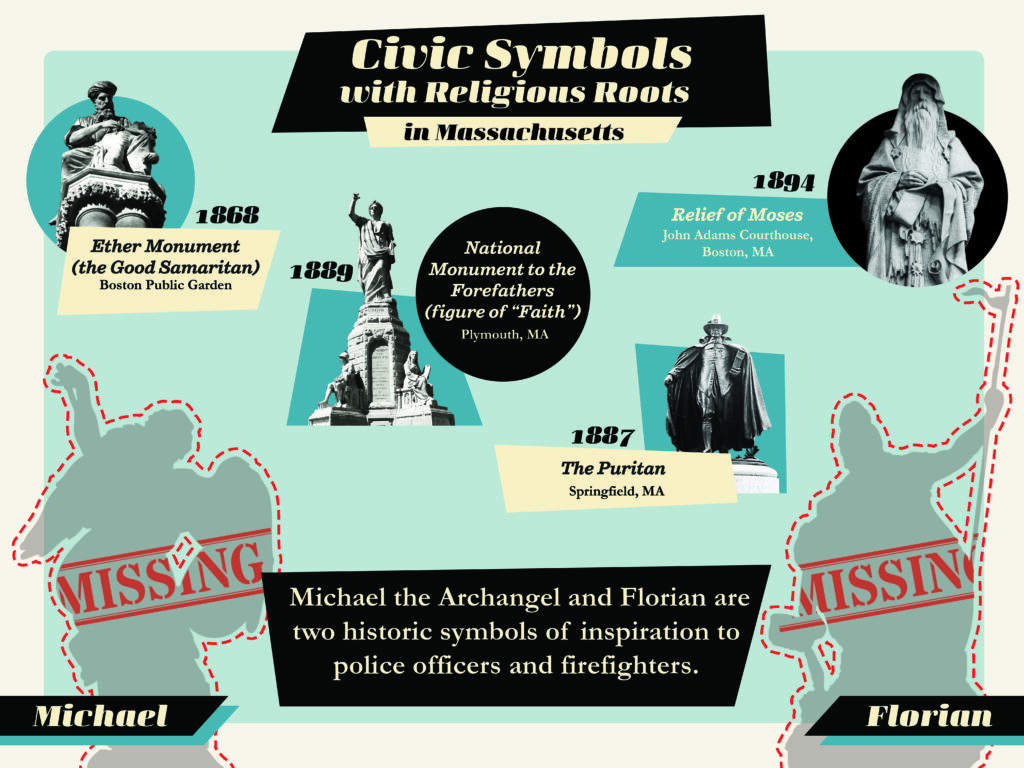
WASHINGTON – The City of Quincy asked the highest court in Massachusetts late yesterday to protect its freedom to honor its firefighters and police officers with Italian-made statues of Florian and Michael the Archangel—two figures recognized the world over as representing first responders’ vital work. In Fitzmaurice v. City of Quincy, the ACLU sued to stop the city from installing the statues at its new public safety headquarters, claiming that because the figures have religious significance to some, they could not be used to honor first responders. Last fall, a lower court judge blocked the installation of the statues, which are now sitting in storage. Along with Quincy’s city solicitor, Becket is fighting back so Quincy won’t have to hide civic symbols awaysimply because some view them as religious.
Around the world, first responders view Florian—an early Roman firefighter—and Michael the Archangel—associated with being a protector against evil—as symbols of their professions. Fire departments often adopt the Florian cross, while police frequently identify with Michael in their mission to safeguard communities.
To honor this longstanding tradition at its new public safety headquarters, the City of Quincy commissioned statues of Florian and Michael from the same artist who created the city’s John Adams and John Hancock statues. The goal: pay tribute to public servants using symbols already meaningful to the departments they serve.
“Florian embodies the values that are most important to our work as firefighters: honor, courage, and bravery,” said Tom Bowes, president of Quincy’s Firefighters Local 792. “We represent these values when we are out on the street every day fighting fires and serving the people of Quincy. The city wants to inspire that service by including a statue of Florian as part of the Public Safety Headquarters. That should unite Quincy, not divide it.”
The statues were created months ago by an Italian art studio. But before the statues could be installed, the ACLU sued on behalf of a group of residents, arguing that Quincy could not honor its first responders in this way because Michael and Florian are viewed as saints by some faith traditions, including the Catholic Church. Now the statues are languishing in a warehouse.
The ACLU’s extreme position would force cities to strip historic symbols from public spaces whenever they carry religious associations. But the Supreme Court has upheld the public display of symbols with religious roots, including a World War I memorial featuring a cross, when they carry historical, cultural, or commemorative significance. Becket is fighting for Quincy’s ability to continue this tradition without being forced to treat religion as something toxic and unwelcome in public life.
“The ACLU’s theory in this case is tragically simple: if beautiful art has religious meaning to anyone, it must be hidden away from everyone,” said Joseph Davis, senior counsel at Becket and an attorney for the City of Quincy. “What’s even worse is that this is art designed to help and honor our firefighters and police. The ACLU’s radical rule flouts our nation’s civic heritage and decades of court decisions. The Justices of the Supreme Judicial Court should reject the ACLU’s Puritanical demands and make clear that artworks don’t have to be purged from the public square just because they might make someone think of religion.”
In addition to Becket, Quincy is also represented by the city solicitor, James Timmins.